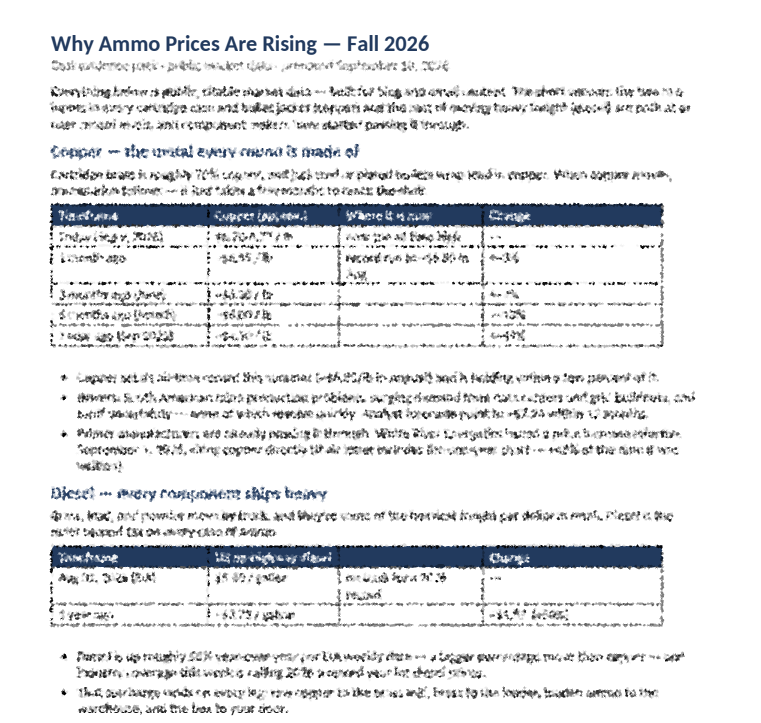
Copper does not care what you paid for 9mm last spring. It set a COMEX record of $6.8035 a pound on September 9, then cooled a few cents. That is still roughly 36 to 40 percent above the $4.54 area from mid-September 2025.
Cartridge brass is about 70 percent copper. Jacketed and plated bullets wrap lead in the same metal. When that chart runs, ammunition follows. It just takes a quarter or two to show up in the case price on a retail shelf.
Diesel is the other half of the bill, and it has been uglier on a percentage basis. EIA’s U.S. on-highway diesel print for the week of August 31 sat at $5.599 a gallon. The week of September 7 jumped to $5.967. A year earlier that number lived near $3.73 to $3.77. Call it about fifty percent, give or take the week you pick. Retail trackers then printed fresh records around $5.85 to $6.00.
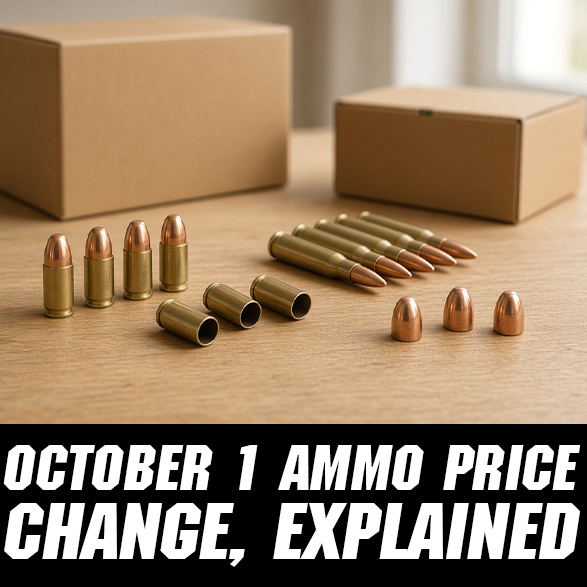
Those two inputs — the metal in the case and the fuel that moves pallets — are why component letters started landing this summer, and why loaded-ammo pricing is set to move October 1.
The metal in every round
People talk about “ammo inflation” like it is a mood. It is a commodity.

Copper spent August and early September hugging all-time highs. The summer peak on the COMEX tape was $6.8035. Even after this week’s pullback into the mid-$6.30s, the metal is still far above last fall. Analysts and trade desks have been pointing at the same pile of reasons: mine trouble in South America, Chile’s ore grades, data-center and grid demand, and tariff positioning that pulled metal into U.S. warehouses.
None of that unwinds on a range-day schedule.
White River Energetics, a primer maker, put a price increase on the books effective September 1 and pointed at copper in the letter. That is the receipt. Primers are a tiny part of a cartridge by weight and a huge part of whether a factory can keep a line running. When the primer house moves, loaders do not wait around for a nicer copper print in November.
Brass has already been tracking the same chart with a short lag. In this year’s component market, 9mm case brass is up about 21 percent since spring. 5.56 brass is up about 10 percent. Copper is still sitting on the high end of the tape, so there is no clean “it broke, we’re fine” signal in the input.
Powder has stepped up through 2026 with the rest of the chain. Propellant is not copper, but it rides the same freight and the same chemical-plant cost structure.
The $2 diesel tax on a case of ammo
Brass, lead, and powder are miserable freight. Heavy, dense, not much dollar value per pound compared with consumer electronics. Every extra dollar at the pump shows up as a fuel surcharge on the truck that takes cathode to the mill, brass to the loader, and cases to the warehouse.
August’s national diesel average from BTS was $5.46 a gallon, up 45.9 percent from August 2025. EIA’s weekly series then punched through that. Forbes and pump-price trackers spent the second week of September writing “record” in the headline, with some prints crossing $6.
That surcharge does not hit once. It hits four times before a box lands on a porch.
Three suppliers already moved. Loaded ammo is next.
Berry’s Bullets in St. George, Utah, reset OEM manufacturer pricing effective July 8. Plated bullets are copper over lead, so both raw inputs have been climbing all year. On the highest-volume projectile in the country — 9mm 115-grain — that letter worked out to about $3.50 per thousand, $53.44 to $56.94, a 6.5 percent jump. One .30-caliber subsonic SKU took a $35-per-thousand hit for October, roughly 22 percent on a single component of a single round.
Count the letters:
- Bullets: Berry’s, July
- Primers: White River Energetics, September 1
- Brass: tracking record copper all year
Every piece of a loaded cartridge now costs more than it did in March. Loaders held as long as they could. Then they stopped holding.
One manufacturing partner put it in writing this month:
“For the past six months we’ve held our pricing flat while copper climbed to record highs and freight costs rose with it — we absorbed the increases ourselves rather than passing them on. It’s reached the point where we can’t absorb that percentage anymore. Component and transportation costs have permanently reset, and pricing adjusts October 1.”
That is not a scare email from a marketing intern. That is a factory saying the discount window is the rest of September.
Fall demand on top of a real cost wave
Ammo always gets tight when weather cools, hunting seasons open, and people remember they burned their stash over the summer. This year that seasonal bump is landing on inputs that actually reset.
Copper at or near a record is not “vibes.” Diesel at a record is not a retailer testing you. Primer and bullet houses already published numbers. The October 1 loaded-ammo adjustment is the last shoe.
Buyers who wait for a January “correction” are betting the mines, the grid buildout, and the diesel crack all get friendly at the same time. Possible. Not the way the last twelve months have traded.
What is worth buying before the reset
Match the purchase to how you shoot, not to a panic list.
9mm. Highest volume, first place the new component math shows up. If you train, this is the caliber where a 6 to 10 percent box increase turns into real money over a winter of classes.
5.56 / .223. Brass is up less than 9mm so far, which is the tell that more of that increase is still in transit. Cheap to skip now. Expensive to need in November.
Defensive and subsonic SKUs. The .30-cal example in the Berry’s letter is the warning shot. Low-volume, specialty bullets move in ugly jumps because there is no giant production run to spread the copper across.
Primers and brass if you reload. The WRE letter already hit. Empty cases will not get cheaper while copper sits above $6.
Do not clean out a shop’s last crate of something you do not shoot. Do lock in a few months of what you actually burn, at the price still on the site today.
The short version
Copper: record $6.80/lb on September 9, still elevated after a mid-September dip, up on the order of 36–49 percent depending on the exact year-ago print you use.
Diesel: EIA $5.60 on August 31, $5.97 the next weekly print, retail records near $6, about +50 percent year over year.
Components: bullets in July, primers September 1, brass already following copper.
Loaded ammo: October 1.
Current pricing is the lag. After October 1 you are paying the new metal and the new freight.
Don’t believe us? Here’s the proof– from the suppliers themselves