

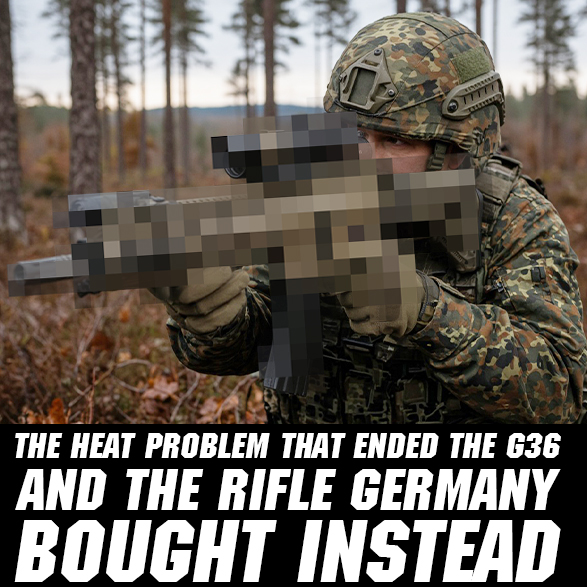
The G36 has been the German soldier’s rifle since the late 1990s. That run is finished.
First rifles reached Panzergrenadier Battalion 122 at Grafenwöhr in December 2025. Training is now spreading through the units scheduled to receive them. By the end of 2026, roughly 20,000 of the short-barrel G95KA1 should be in the force. Heckler & Koch and the procurement office have already locked in the full framework for 250,000 rifles.
The polymer G36 that looked futuristic in the 1990s is being parked. In its place sits a metal-bodied, AR-pattern rifle Germany designated G95.

Why the G36 Was Finished
The break started in public in 2015. Then-Defense Minister Ursula von der Leyen said the rifle had a “precision problem at high temperatures and when hot from firing.” Tests showed groups opening up after as little as two magazines. At 200 meters the shift could be half a meter; at 500 meters it was far worse. The polymer barrel support softened. The barrel no longer sat true.
HK pushed back on test methods. Soldiers who used the G36 in Afghanistan often liked the light weight and the folding stock. None of that changed the political decision. Von der Leyen said the G36 had no future as the standard rifle. The replacement program, “System Sturmgewehr Bundeswehr,” opened in 2017.
A tender followed. Haenel briefly won, then lost after patent fights. The contract went back to Heckler & Koch for a Bundeswehr-specific HK416 A8. Special forces had already been running a related G95K since 2019. The line units are now getting the A1 and KA1 versions.
What the G95 Actually Is
The G95 is a short-stroke gas-piston rifle with a rotating bolt. Gas taps off the top of the barrel, drives a piston and operating rod, and cycles the bolt. Cyclic rate is listed at up to 850 rounds per minute. Construction is mostly metal rather than the G36’s polymer shell. That is the point: the barrel stays put when it gets hot.
Two configurations:
- G95A1 — 16.5-inch (419 mm) barrel
- G95KA1 — 14-inch (355 mm) barrel
Most soldiers will get the short one. It fits vehicles and buildings better. The longer barrel keeps a bit more velocity for units that want it. Effective range for both is listed at 450 meters.
The stock telescopes. It does not fold. The buffer and spring live in the stock, so there is no side-fold like the G36. Length of pull adjusts. Controls are ambidextrous. The charging handle sits at the rear of the upper receiver — the change soldiers mention first when they pick the rifle up.
Finish is RAL 8000 green-brown, not black. Black shows up more readily under night-vision. Magazines are narrower than the G36’s while still holding 30 rounds of 5.56 NATO.
Standard glass is the ELCAN Specter DR 1-4x with a piggyback reflex. A Rheinmetall LLM-VarioRay laser-light module rides the rail. Folding backup irons sit at 45 degrees. The handguard uses a STANAG 4694 / NATO accessory rail for bipods, hand stops, night optics, or a 40 mm launcher when needed.
A suppressor exists for selected units. Regular issue gets a flash hider.
Numbers Next to the Old Rifle
Official Bundeswehr figures, bare rifle first, then the fighting weight with optic, laser module, and a loaded magazine:
| G95KA1 | G95A1 | G36A1 | |
|---|---|---|---|
| Max length | 878 mm | 942 mm | 1,000 mm |
| Min length | 796 mm | 860 mm | 750 mm |
| Barrel | 355 mm | 419 mm | 480 mm |
| Weight, bare | 3.3 kg | 3.4 kg | 3.6 kg |
| Weight, equipped | 4.3 kg | 4.4 kg | 4.1 kg |
| Cyclic rate | 850 rpm | 850 rpm | 750 rpm |
| Effective range | 450 m | 450 m | 500 m |
The G95 is a little heavier once everything is hung on it. The G36 still wins on folded length. Soldiers who have shot both say the new rifle does not feel as nose-heavy. That matters more than the extra couple of hundred grams when you hold a position.
What the First Units Said After Live Fire
Two soldiers from 4th Company, Battalion 122 — Sergeant Major Alex S. and Staff Sergeant Mike K. — talked after they had run the G95 on the range.
Alex S. said the weight sits more evenly. The muzzle does not dip as fast when you stay in position. Mike K. said the rifle and magazines are slimmer, so reloads feel cleaner. Both flagged the rear charging handle. Muscle memory from the G36’s handle takes a few sessions to overwrite.
The rifle also wants more oil than the G36. One officer put it plainly: a drop more lube, far fewer stoppages if you keep it clean. That is the trade. Polymer shrugged off neglect. Metal and a piston system do not.
Jägerbataillon 1 in Schwarzenborn started conversion in 2026 and reported the same mix: better handling and precision, extra care required.
The Order Got Bigger — Twice
The first signed quantity sat near 119,000 rifles. The Bundestag budget committee raised the ceiling to 250,000 in December 2025. Cost sits around €800 million for the rifles and associated kit. Heckler & Koch is putting more than €230 million into new machinery and plant through 2028 so it can keep a 20,000-rifle-a-year cadence. BAAINBw fully invoked the framework in July 2026.
Germany is also growing the force — active strength toward 260,000 plus a much larger reserve. Reports in summer 2026 suggested another 250,000 rifles could follow so reservists and homeland units do not stay on leftover G36s. That second tranche is not a signed contract yet. The first 250,000 already change the scale of the program.
Full issue across the force is planned through 2031.
What Changes on the Ground
Shared controls with the G27 and G28 (the AR-10-pattern designated marksman and support rifles already in service) cut the training tax. NATO partners already run HK416 variants. Magazines, rails, and basic handling line up.
The G36’s folding stock was handy in vehicles. The G95’s collapsing stock is shorter than the old rifle with the stock out, but it will not tuck as flat. Units living in Boxers and Pumas will notice. Urban work favors the 14-inch KA1. That is why it is the default issue gun.
Accuracy when the barrel is hot was the original complaint. Metal construction and a free-floated-style barrel path are the answer Germany bought. Whether every line company keeps the same discipline on lubrication that special forces already practice on the G95K will decide how clean the transition stays.
The G36 is not disappearing overnight. Stocks will linger in training units and with some reserves for years. For the battalions receiving the G95 now, the polymer rifle that defined a generation of German infantry is already the old gun.