


ATF Director Rob Cekada just published a straightforward piece on The Hill that cuts through a lot of the noise surrounding the agency’s big regulatory package. The timing matters. Several of these proposals hit the Federal Register in May, and comment periods on key ones close today.
Cekada’s article focuses on three areas that have drawn the loudest criticism: the definition of who counts as “adjudicated as a mental defective,” updates to non-over-the-counter (online or remote) sales within the same state, and the formal repeal of the 2024 “engaged in the business” rule. He argues the coverage has inflated the scope and ignored the actual text.
Start with the mental health piece, because that’s the one generating the most heat. The Gun Control Act of 1968 prohibited firearm possession by people “adjudicated as a mental defective” or “committed to a mental institution.” Congress meant a narrow category—people with serious, lasting intellectual disabilities who couldn’t manage their own affairs. Over the years the regulatory definition drifted. By the 1990s, a veteran who needed a VA fiduciary just to handle benefit payments could end up in NICS as prohibited, even with no finding of danger or permanent incapacity. Same story with some Social Security disability cases.
The proposed rule tightens that definition back toward the original statute. People under court-ordered guardianship because of mental illness or intellectual disability, and those committed to a mental institution, stay prohibited. Someone who simply needs help managing government benefits does not. Cekada notes that ATF’s own cost-benefit analysis acknowledged a range of possible risks, including remote mass-casualty scenarios—standard language in these analyses—and that the public comment process exists precisely so those concerns can be examined. The claim that the agency is “arming the mentally ill” does not match the text.
Second change: non-over-the-counter sales. Federal law has allowed same-state, non-face-to-face transfers by licensed dealers since 1968, with conditions: notice to the buyer’s local chief of police and a seven-day wait. Old regulations assumed in-person ID checks. The proposal updates the process for modern tools. Background checks remain mandatory. Local law enforcement still gets notice. The seven-day wait stays. The new requirement adds remote identity proofing—live video for facial comparison plus a separate federal ID verification through independent channels. Every transfer still runs through NICS. Bulk purchases and trafficking indicators continue to flag.
Third, the formal repeal of the 2024 “engaged in the business” rule. That regulation tried to expand who needed a dealer’s license through agency rulemaking rather than statute. A federal court vacated it nationwide. ATF’s own data showed it reduced licensee applications and, counterintuitively, the volume of background checks. Removing the vacated language simply cleans up the books.
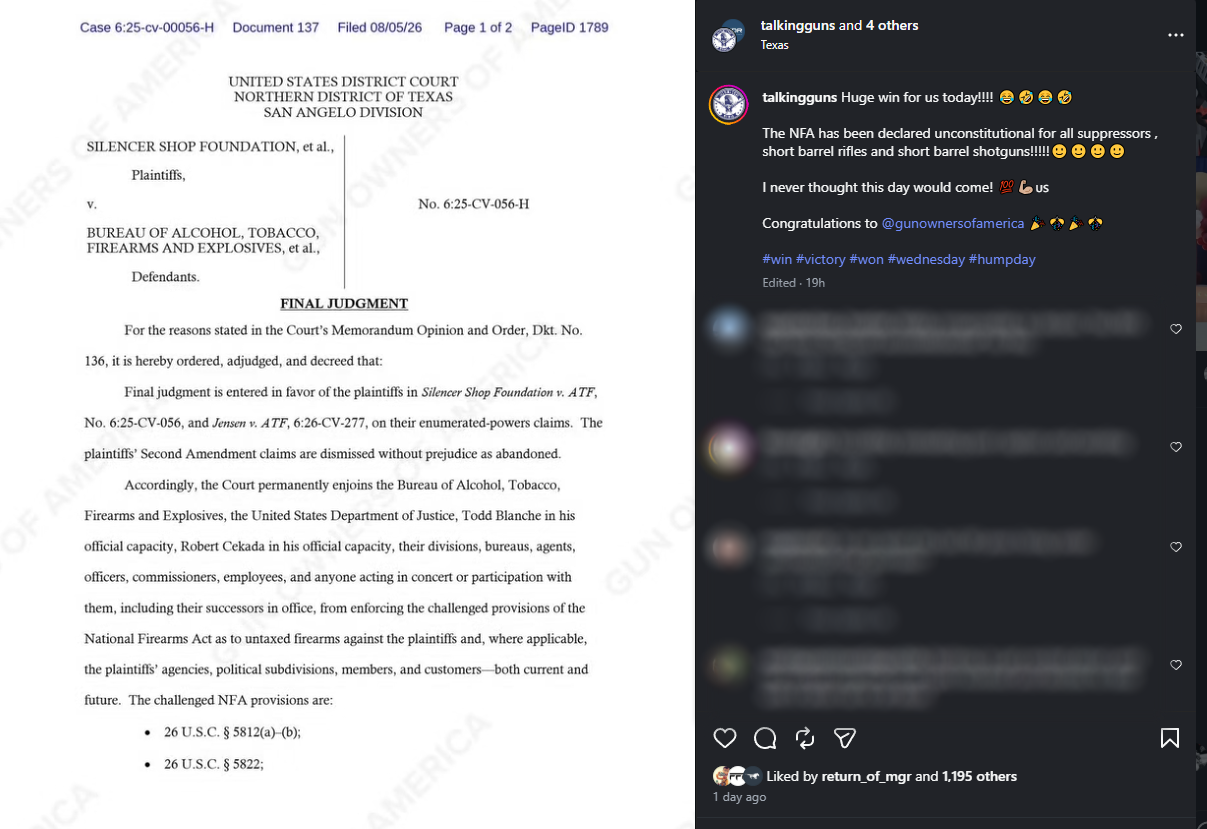
These three items sit inside a much larger package. After Cekada’s confirmation in late April, the Justice Department and ATF released 34 notices of proposed and final rules under the banner of a “New Era of Reform.” The stated goal, tied to the February 2025 executive order on protecting Second Amendment rights, is to strip out regulatory language that exceeded statutory authority, failed in court, or created paperwork without clear public-safety payoff.
Other pieces of that package include formal rescission of the stabilizing brace factoring criteria (already blocked by multiple courts), removal of the bump-stock language from the machine-gun definitions in response to the Supreme Court’s Cargill decision, a major rewrite of Form 4473 to make it shorter and more workable, authorization for electronic recordkeeping by FFLs, definite retention periods for 4473s and A&D books instead of indefinite storage, simplified fingerprint and photo requirements for NFA applications, elimination of the CLEO notification for NFA transfers, joint registration options for spouses on NFA items, and an end to the advance-approval requirement for short-term interstate transport of registered NFA firearms.
The agency also ended the enhanced regulatory enforcement policy that had treated minor paperwork errors as grounds for license revocation and replaced it with a policy that prioritizes actual public-safety and traceability issues.
None of this rewrites the Gun Control Act or the National Firearms Act. Prohibited-person categories remain. NICS checks remain. The core restrictions Congress wrote stay in place. What changes is the regulatory overlay that had grown around them—some of it decades old, some of it recently vacated by courts.
Cekada, a 34-year law-enforcement veteran who came up through the ranks, frames the effort as good government: clearer rules, less room for selective or abusive enforcement, and more attention on violent crime instead of clerical gotchas. The public comment windows exist for a reason. Several of the most discussed proposals close today. Anyone who wants to weigh in still has a few hours left on the Federal eRulemaking portal.
The practical effect for lawful owners and FFLs looks like reduced friction on routine compliance while the statutory prohibitions and background-check system stay intact. That is the argument Cekada is making. The text of the proposals is public. Read it and decide whether the alarm matches the actual changes.
Rules can be found on the following pages: