


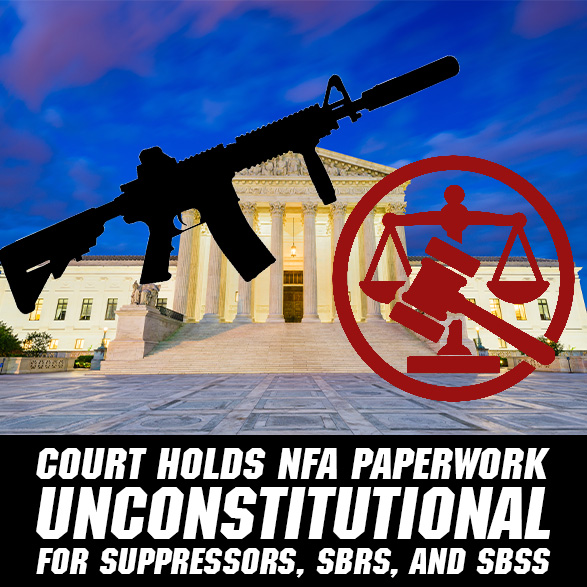
A federal judge in Texas just handed gun owners a major win against one of the oldest federal gun laws on the books. On August 5, 2026, U.S. District Judge James Wesley Hendrix of the Northern District of Texas ruled that the National Firearms Act’s registration, application, fingerprinting, and ATF approval requirements for suppressors, short-barreled rifles, and short-barreled shotguns no longer hold up under the Constitution.
The decision came in Jensen v. ATF, consolidated with Silencer Shop Foundation v. ATF. Plaintiffs included the National Rifle Association, American Suppressor Association, Second Amendment Foundation, Firearms Policy Coalition, Texas State Rifle Association, Gun Owners of America, and several individuals and companies.
Why the Court Struck It Down
Congress passed the National Firearms Act in 1934 as a tax measure. The $200 transfer and making taxes (a serious amount of money at the time) were the constitutional foundation. Registration and the rest of the paperwork existed to help the government collect those taxes. The Supreme Court upheld that structure in Sonzinsky v. United States back in 1937, treating the NFA as a revenue law rather than a pure regulatory one.
That foundation cracked last year. The One Big Beautiful Bill Act, signed July 4, 2025, zeroed out the transfer and making taxes on suppressors, short-barreled rifles, short-barreled shotguns, and “any other weapons.” The $0 rate took effect January 1, 2026. Machine guns and destructive devices still carry the $200 tax.
View this post on Instagram
Judge Hendrix’s 66-page opinion is clear: once the tax disappeared, the regulatory scheme lost its constitutional footing. “Because today’s NFA does not generate any revenue from untaxed firearms, its regulatory provisions cannot be upheld under the taxing power,” the court wrote. The government tried to pivot to the Commerce Clause and the Necessary and Proper Clause. The judge rejected both arguments. Congress originally invoked only its taxing authority, and the court said the government cannot rewrite the statute’s constitutional basis after the fact.
The court deliberately skipped the Second Amendment claims. Plaintiffs had raised them, but the Article I enumerated-powers argument was enough to decide the case.
What the Ruling Actually Does
The court issued a permanent injunction blocking the ATF and Department of Justice from enforcing the challenged NFA provisions—registration requirements, Form 1 and Form 4 applications, fingerprinting, and related criminal penalties—against the plaintiffs, their members, and their customers (current and future). The injunction is party-specific, not a nationwide ban.
Judge Hendrix stayed the order for seven days so the government can seek emergency relief from the Fifth Circuit if it chooses. Expect an appeal.
Practical Impact Right Now
This is a big step, not the final word. For most people outside the protected parties, the paperwork requirements technically remain in place until higher courts or Congress act. Still, the legal theory that carried the day is straightforward and hard to ignore: a tax law without a tax has a serious problem.
Suppressor and short-barreled firearm ownership has already surged since the tax dropped to zero. Wait times and bureaucracy remained the biggest remaining friction points. This ruling attacks those directly for the groups involved in the lawsuits.
NRA-ILA Executive Director Jennifer Commerford called it “a major step in the right direction” while noting the fight to fully repeal the NFA continues. Second Amendment Foundation Executive Director Adam Kraut put it more bluntly: groups want major portions of the NFA in the “dustbin of history.”
Looking Ahead
The decision rests purely on the absence of a valid taxing power. That keeps the Second Amendment arguments available for future cases. Multiple similar challenges are already pending in other districts.
Machine guns and destructive devices remain under the full NFA regime because the tax is still in place. Everything else covered by the zeroed-out tax is now on shaky ground.
This case shows how legislative changes can open constitutional doors that pure Second Amendment challenges sometimes struggle to force. Zeroing the tax was never just about saving $200. It removed the original justification Congress used in 1934, and a federal judge just confirmed it.
Keep an eye on the Fifth Circuit. The seven-day stay means the next move comes quickly. For Tactical Shit readers who run suppressors or short-barreled setups, this is the most significant development on NFA items in years.