


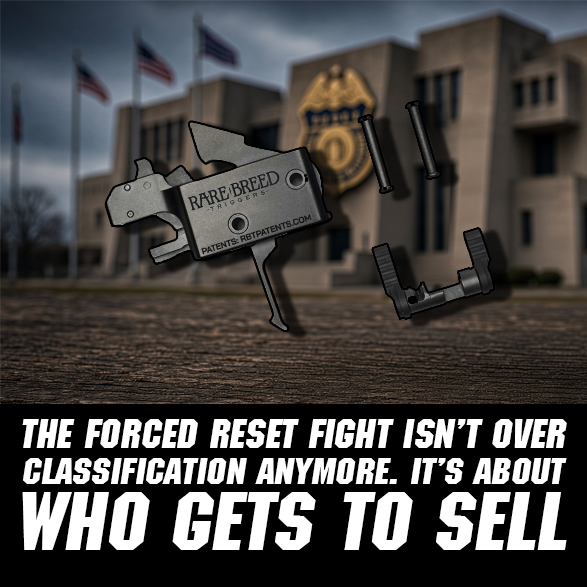
The ATF still will not publish a list. That part matters more than the press-release language.
Director Robert Cekada told an FFL crowd in Dallas that some products sold as forced reset triggers are the real thing, and some “may be” machine guns. He would not say which ones. Manufacturers are supposed to guess. Dealers are supposed to guess. Customers are already guessing.
Then the Justice Department walked into a private patent case and told a federal judge that taking competing Forced Reset Trigger-style products off the market would serve the public.
That is the story. Not a new classification memo. A Statement of Interest.
What landed in the Texas MDL
The fight sits in In re: Rare Breed Triggers Patent Litigation, the consolidated docket in the Eastern District of Texas before Chief Judge Amos Mazzant. Rare Breed Triggers and its patent company, ABC IP, are asserting a stack of patents against makers and sellers of forced-reset hardware. Atrius Development Group is one of the targets. Hoffman Tactical was an earlier one. The Super Safety crowd, Kabuto sellers, WOT sellers — the list has grown through 2026.
On August 31, DOJ filed for ATF. The government said it has a “strong interest” in discouraging the unregulated manufacture of Forced Reset Triggers that allegedly step on Rare Breed’s patents. It also said, in so many words, that ATF has an interest in limiting the sale and distribution of Forced Reset Triggers.
Read that twice. The agency is not telling the court, “this specific Atrius part is a machine gun.” It is telling the court that fewer competing products would be a public good.
Atrius answered on September 24. The company called the filing a backdoor attempt at regulation and said executive agencies do not serve the public by turning private patent enforcement into a government-backed monopoly.
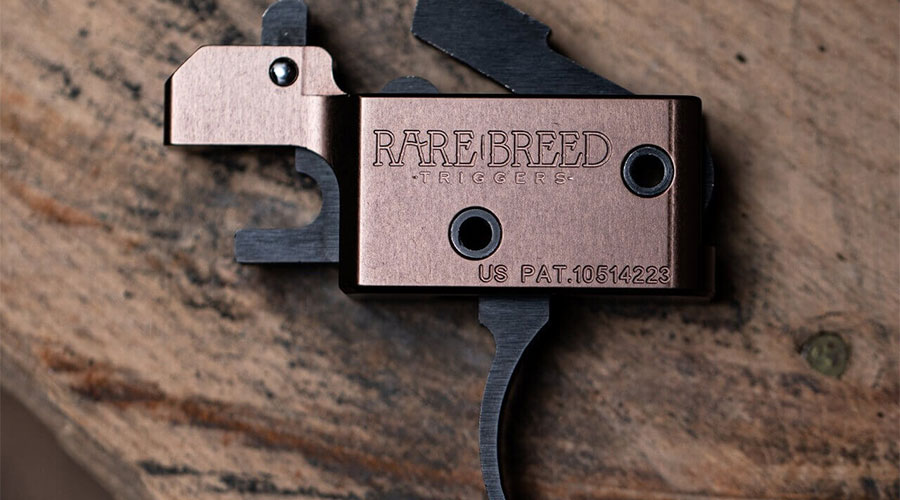
Rare Breed’s Forced Reset Trigger-15 put forced reset hardware on the map. The legal fight now is less about that one trigger and more about who else gets to sell anything in the same neighborhood.
How we got from “is it a machine gun?” to “who owns the category?”
Forced reset devices speed follow-up shots on a semi-auto by forcing the trigger back to a reset as the bolt cycles. The statutory machine-gun test is still the old one: does the gun fire more than one shot automatically by a single function of the trigger?
ATF spent years trying to treat Forced Reset Triggers as machine guns. Courts did not play along. In National Association for Gun Rights v. Garland, the classification theory took a beating because a forced reset still needs a separate trigger function for each shot. The government settled with Rare Breed in May 2025 instead of riding the Fifth Circuit appeal all the way out. Rare Breed could keep selling, with conditions. No handgun Forced Reset Triggers. And Rare Breed would enforce its patents against other makers.
That last sentence is doing a lot of work now.
ATF already stuck its head into Rare Breed’s suit against Hoffman Tactical back in January, citing public safety. The August filing in the Texas MDL is the same move on a bigger stage.
If you only followed the 2021–2024 classification war, this looks like a subject change. It isn’t. The agency lost the clean statutory argument, at least in the cases that mattered. Patent court is the next room.
Atrius’s pitch: this isn’t even an Forced Reset Trigger
Atrius does not want to fight on Rare Breed’s terms. It calls its product a Forced Reset Selector — FRS, not Forced Reset Trigger — and says the selector-based design is built differently and operates differently from the claims in Rare Breed’s patents. It also says those patents should not hold up.
Whether that is true is a claim-construction problem for Judge Mazzant, not a blog. What is true, on the public filings, is that DOJ did not classify the Atrius FRS as a machine gun in the Statement of Interest. It did not point to a shooting, a criminal case, or a specific mechanical finding on that product. It argued public interest in the abstract.
Cekada’s comments the same week made the gap worse. Some Forced Reset Triggers are Forced Reset Triggers. Some might be machine guns. No names. Swapping the letters on the box from Forced Reset Trigger to FRS will not save you if the mechanism fails the statute. Fine. Then publish the test results. The agency has not.
Gun shops are left holding inventory that might be a civil-infringement problem, a criminal-classification problem, both, or neither, depending on which office you ask and whether anyone is willing to put it in writing.

ATF headquarters in Washington. The agency will talk about public safety in patent court. It still will not publish a product-by-product line.
The part that should bother people who do not care about trigger brands
Patent owners sue. That is normal. Rare Breed spent years and a pile of money getting its product through ATF’s first war. Competitors showed up with cheaper parts, open-source-ish designs, and different marketing. Some of that may be infringement. Some of it may be prior art. Courts exist for that.
The odd piece is the federal government leaning on the scale after it already extracted a settlement that requires Rare Breed to police the category.
Atrius put it bluntly: this looks like a monopoly with a badge standing nearby.
You do not have to like Atrius, or Rare Breed, or $20 clone triggers to see the pattern. Congress did not pass a “one licensed Forced Reset Trigger vendor” statute. ATF did not win a nationwide machine-gun ruling that covers every forced-reset idea on the market. So the pressure moves into injunction practice — pull the other products, call it safety, keep the criminal threat in reserve for whatever design the agency still refuses to name.
That is not clarity. Clarity would be a published classification letter, or a regulation with notice and comment, or a statute. This is something else.
What happens next
The Texas court still has to do patent work: claims, validity, infringement, injunction factors. Depositions in the MDL were already running in mid-September. Atrius says it will keep defending the FRS and its customers. Rare Breed wants competitors off the floor. ATF wants fewer Forced Reset Triggers in circulation and would like the civil docket to help.
None of that tells a dealer whether the part in the display case is lawful next month. That is the live problem, and it is the one Cekada declined to solve in Dallas.
If the government thinks a given mechanism fires more than one round by a single function of the trigger, it should say so on letterhead. If it thinks the problem is only patent law, it should stay out of the private case. Doing both at once — hint at felonies, decline to specify, then applaud an injunction — is how you get a chilled market without ever winning the argument Congress wrote.