

Seven weeks after a Texas judge blocked National Firearms Act registration for covered suppressor and short-barreled firearm transfers, ATF Director Robert Cekada finally answered the question dealers have been asking since August.
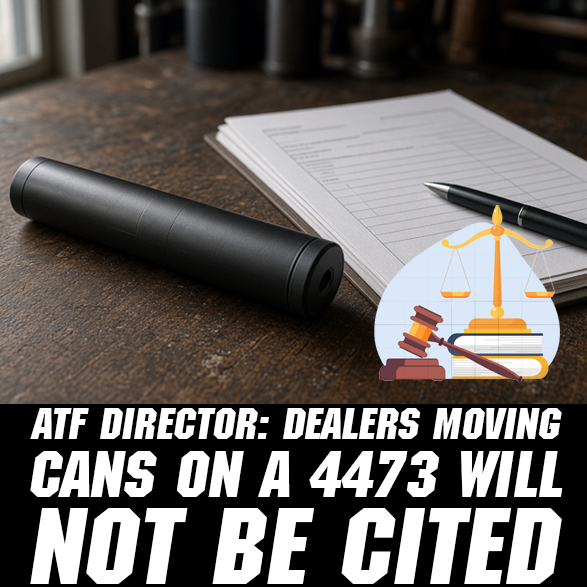
An FFL found transferring suppressors on a Form 4473 will not be cited for that practice. Former NFA Division Chief Steve Albro went further: ATF’s working posture is to presume those transfers were legal. Cekada also said the written guidance is close—weeks, not months—and that ATF is only one of three offices that have to sign off. The other two are the Justice Department and the White House.
That is the most useful thing anyone in the Bureau has said in public since the injunction took effect. It is still not a memo. Shops that have been sitting on inventory since mid-August now have to decide whether a director’s remarks at an industry briefing are enough to open the safe.
What Cekada Actually Said in Dallas
The comments came at “The Briefing,” a FastBound FFL compliance event. AmmoLand’s John Crump asked Cekada, on the record, how Industry Operations Investigators should treat a dealer transferring cans on a 4473. Cekada did not hedge. No citation for that transfer.
Albro put a number on why the delay has been so expensive: more than 2.3 million suppressors sold this year. A lot of those units are already in dealer inventory. Some left the building on a 4473. A lot more have been sitting because the shop owner did not want to bet a license on a court order the Bureau had not explained.

Cekada also sketched the rest of the package. The forthcoming document is supposed to cover:
- suppressor transfers already happening on Form 4473
- short-barreled rifles and short-barreled shotguns, which have been the messier category
- interstate travel with covered items
- the 15 states that still write federal NFA compliance into their own statutes
He said the point of the guidance is to cover as many people as the injunction allows, and to lock that protection in so a later administration cannot casually walk it back. He also said ATF is not going to turn the Texas order into a nationwide, everyone-everywhere rule on its own.
AmmoLand’s sources think the White House is the office slowing the release. That matches the three-stakeholder description Cekada gave. Until the PDF is posted, every shop is still making its own call.
The Court Order Did Not Repeal the NFA
This is where a lot of social-media summaries go off the rails.
On August 5, 2026, Judge James Wesley Hendrix of the Northern District of Texas entered final judgment in Silencer Shop Foundation v. ATF, consolidated with Jensen v. ATF. He held that the NFA’s registration and advance-approval scheme exceeds Congress’s enumerated powers as applied to untaxed silencers, short-barreled rifles, and short-barreled shotguns. Congress had already dropped the $200 making and transfer tax on those items to $0 in the One Big Beautiful Bill Act, effective January 1, 2026. Hendrix’s opinion treats the leftover paperwork regime as a tax collection system with nothing left to collect.
The government got a seven-day stay. It let the stay expire. The injunction took effect August 13. That night, Gun Owners of America members Brandon Herrera and Wes Virdell took possession of suppressors at Silencer Shop in Leander, Texas, without a Form 4. GOA called it the first lawful unregistered commercial suppressor transfer since June 26, 1934.
Machine guns and destructive devices were not pulled out of the NFA. Background checks under the Gun Control Act still apply. State bans still apply. The order is party-specific: named plaintiffs, members of the organizational plaintiffs, and current and future customers of the commercial plaintiffs. It is not a statute Congress repealed. Legal analyses after the ruling have been blunt about that point. An unappealed loss against one set of parties does not automatically estop the United States against every other dealer and buyer in the country.
That is why so many counters froze. The court told ATF to stop enforcing certain provisions against certain people. It did not mail every FFL a new operations manual.
Why Form 4473 Became the Fight
For covered suppressor sales, the practical substitute has been the same form used for a rifle or a pistol: ATF Form 4473, plus a NICS check. No fingerprints. No passport photo. No CLEO sign-off. No Form 4 wait. SilencerCo told qualifying customers in 27 states they could buy that way at participating dealers, and then warned them not to drive the can across a state line until someone answers the travel question. Missouri is on that list. So are Texas, Florida, Tennessee, Arizona, and most of the usual shall-issue map.
Plenty of shops still refused. NSSF’s Mark Oliva said in August that being bold might not be in a dealer’s best business interest. Silencer Central’s Brandon Maddox made the same observation from the other side of the counter: ATF is not usually in the business of interpreting a judge’s order in real time.
Then the inspections started landing. They were routine cycle audits, not raids. Four FFLs in four regions—East Coast, South, Midwest, Southwest—had already been moving covered suppressors on 4473s. Inspectors closed all four files without citing those transfers. Some shops marked the items disposed in the NFA bound book and moved them onto the GCA books before the 4473. Inspectors accepted that in at least two of the states.
Cekada’s Dallas answer lines up with those inspection results. It still leaves the shop owner who has never been a plaintiff, and whose customer is not a member of a plaintiff group, staring at the same gray area.
SBRs Are Not the Same Problem as Cans
Suppressors were the easier category. Short-barreled rifles and short-barreled shotguns ran into a second statute.
Even after Hendrix blocked the NFA registration pieces, 18 U.S.C. § 922(b)(4) still generally bars an FFL from transferring an SBR or SBS unless the Attorney General has authorized the transfer. For decades, a approved Form 4 was that authorization. Take the Form 4 away and the GCA provision is still sitting there. That is why a lot of dealers kept running SBRs on Form 4 after they had already started running suppressors on a 4473.
AmmoLand reports the coming guidance is supposed to “fix” that carve-out, which the outlet reads as SBRs and SBSs moving on a 4473 alone. Cekada called the guns themselves a non-issue and criticized groups that treat them as props. Until the document is public, that remains a report about what ATF intends to do, not a rule a compliance officer can file.
Travel, the 15-State Problem, and Everything Else Still Open
Interstate movement is the question that will generate the first ugly test case if ATF gets this wrong.
The injunction has no geographic limit in the judgment itself. State law does. About 15 states still require some form of federal NFA compliance for items they allow at all. Cekada said the guidance may address those states. ATF Chief Legal Counsel Robert Lieder added the limit everyone already knew: the Bureau cannot order a state legislature to accept ATF’s reading.
Other items that came up in Dallas, and that should not get mixed into the NFA memo:
- A revised Form 4473 is coming, including deletion of the county field and changes tied to the Supreme Court’s Hemani decision on the marijuana-user prohibition. Lieder said that form will not ship until after the holiday season. That is a separate project.
- ATF is updating systems to allow handgun and handgun-ammunition sales to 18- to 20-year-olds after a DOJ Office of Legal Counsel opinion the Bureau reportedly was not warned about. Machine guns and destructive devices are expected to stay at 21.
- On forced-reset triggers, Cekada said some products on the market are FRTs and some meet the statutory machine-gun definition. He would not name brands.
Useful context. Different pile of paper.
The October 5 Clock
CBS reported on September 17 that President Trump personally directed the Justice Department not to appeal Hendrix’s ruling, and that he told Republican members of Congress he would keep DOJ from contesting it. A DOJ official told the network the department intends to inform Congress it will not appeal. The outside date circulating in industry and press coverage is October 5.
A White House spokesperson, in the same cycle, stressed that prohibited persons are still prohibited and that other federal firearms crimes remain in force. That is true and also not the question dealers have been asking. The question has been: what form do you fill out, and will an IOI treat it as a violation next spring?
If October 5 passes with no notice of appeal, the judgment becomes much harder to unwind for the parties already covered. It still does not rewrite state codes, and it still does not invent a travel rule.
What a Buyer Should Do Before Driving to the Shop
Call first. Ask three things.
- Are you transferring covered suppressors on a 4473 right now, or are you waiting for ATF’s memo?
- Who do you treat as a covered buyer—Silencer Shop / SilencerCo / PSA / B&T customers, members of GOA, TSRA, CCRKBA, FPC Action Foundation, and the other plaintiff groups, or a wider set?
- Will you transfer an SBR the same way, or only after the guidance lands?
Cekada has now said a shop that transfers a suppressor on a 4473 will not be cited for doing it. Four inspections already came out clean. A lot of FFLs will still wait for letterhead. After a decade of watching the Bureau treat a checked box as a hanging offense, that caution is not mysterious.
The written guidance is the document that ends the guessing. Cekada says it is close. Until it is posted, the legal facts are the ones that have been true since August 13: the NFA was not repealed, some people can already walk out with a can after a background check, SBRs are still tangled in a different statute, and state lines still matter.
FAQ
Can anyone buy a suppressor on a Form 4473 now?
No. Coverage tracks the plaintiffs, their members, and the commercial plaintiffs’ current and future customers, plus state law. Dealers set their own risk tolerance on top of that.
Will ATF cite a dealer for a 4473 suppressor transfer?
The director said no. Former NFA Chief Steve Albro said the policy is to presume those transfers were lawful. Written guidance has not been published.
Are SBRs in the same boat?
Not yet. The GCA’s Attorney General-authorization rule is the leftover problem. ATF says the forthcoming memo will address it.
Did the Justice Department appeal?
As of the last public reporting, no. CBS says the White House directed DOJ not to. The date being watched is October 5.
Does this override my state?
No. ATF cannot force the 15 states that still incorporate federal NFA compliance to change their statutes.