


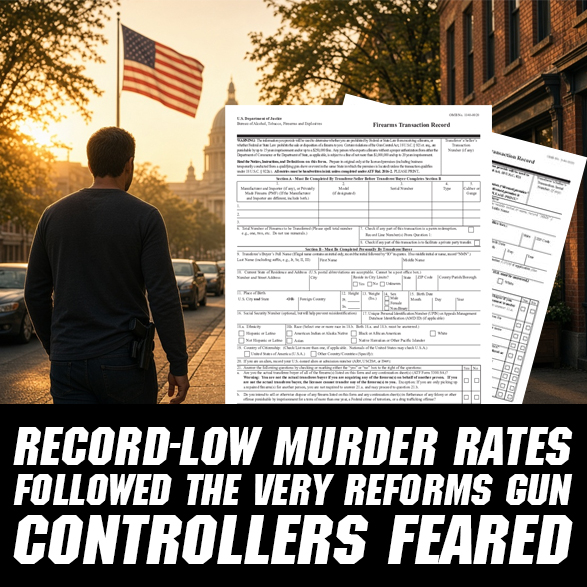
Remember the warnings?
After the Supreme Court handed down the Bruen decision in 2022, gun control groups didn’t just disagree—they went full apocalypse. Brady said it would “assuredly result in more gun violence immediately.” Everytown’s Eric Tirschwell claimed more people would be “intimidated, wounded and killed.” New York City’s mayor at the time, Eric Adams, fretted about the city turning into the “Wild West.” California’s attorney general warned that more guns in more places would make everyone less safe.
That was just the start. The Second Amendment Foundation recently compiled 85 of these kinds of statements into a factsheet called “The Bloodbath That Never Came.” It covers everything from Bruen and permitless carry laws in places like Texas and Florida, to the Supreme Court striking down the ATF’s bump-stock ban, to the recent move toward zeroing out the NFA tax on suppressors and short-barreled firearms.
The predictions were clear: expand the right to carry, roll back some of the more aggressive ATF interpretations, and America would drown in blood.
What actually happened? The opposite.
The Numbers Don’t Lie
According to revised FBI figures tracked in the SAF factsheet, estimated U.S. murders dropped from 21,923 in 2022 to 14,085 in 2025. That’s a 36% decline. The rate fell from 6.6 per 100,000 residents down to 4.1—tying the FBI’s historical low.
The drops got bigger each year: 9.1% in 2023, 13.7% in 2024, and an 18.1% plunge in 2025. That last one is described as the fastest recorded decline in murders. Violent crime overall fell 9.3% in 2025, the largest one-year drop since the FBI started national estimates back in 1936.
Preliminary data for the first half of 2026 looks even better in some reporting areas, with murder rates down another 20.8% compared to the same period in 2025. Cities that were supposed to be especially vulnerable after Bruen saw major improvements. New York City recorded just 688 shootings in 2025—the lowest on record. Baltimore’s homicides hit 133, the fewest in nearly 50 years. New Jersey saw shooting victims drop sharply for a third straight year.
Texas, which went permitless carry earlier, saw its murder rate fall 27.3% from 2021 to 2024. Florida recorded an 18.8% drop in its murder rate in 2024, the first full year after its constitutional carry law took effect. All seven index offenses declined there that year.
Even the broadest mass-shooting counts (four or more people shot, not counting the shooter) fell from 659 incidents in 2023 to 407 in 2025, according to the Gun Violence Archive’s own wide definition.
Predictions vs. Reality
The SAF factsheet doesn’t claim that any of these Second Amendment advances caused the drop in crime. Crime has lots of drivers, and nobody serious pretends otherwise. What it does is document the specific forecasts of imminent disaster and put them next to the actual trends.
Those forecasts came from the usual places: Brady, Everytown, Giffords, Moms Demand Action, elected officials, and attorneys general. After Bruen alone, there were 39 documented warnings. Seventeen more tied to states adopting permitless carry. Eleven after the bump-stock ruling. Another eleven around the NFA tax changes. Seven more related to other Trump-era DOJ and ATF moves.
Time and again, the prediction was more guns equals more deaths. More legal carry equals chaos. Ending certain ATF rules equals blood in the streets. Zeroing the NFA tax equals a return to Al Capone-style mayhem.
None of it materialized. Instead, the years that followed the biggest recent expansions of gun rights saw the steepest drops in murder.
Why This Matters for the Rest of Us
For people who actually own firearms, train with them, and carry them, this isn’t abstract. The same groups that spent years insisting that restoring the right to carry outside the home would turn cities into shooting galleries are the ones still pushing for more restrictions on the gear we use every day—suppressors, short barrels, standard-capacity magazines, and the rest.
The data doesn’t require anyone to prove that more rights automatically produce less crime. The Second Amendment isn’t conditioned on crime statistics. But it does make the old talking point harder to sustain: that every incremental restoration of rights is a guaranteed public-safety disaster.
The bloodbath was predicted, repeatedly and confidently, by the people who still want to write the rules. The numbers that followed went the other direction.
If you’re already in the market for quality gear that helps you exercise those rights effectively and responsibly, the trends suggest the sky didn’t fall when those rights expanded. It never does. The predictions just keep coming anyway.