



You have probably seen the headlines. An armed civilian stops a shooter, and the coverage treats it like a unicorn sighting. “Rare.” “Uncommon.” “Almost never happens.” Those words show up again and again, usually right next to a citation of the FBI’s active shooter reports.
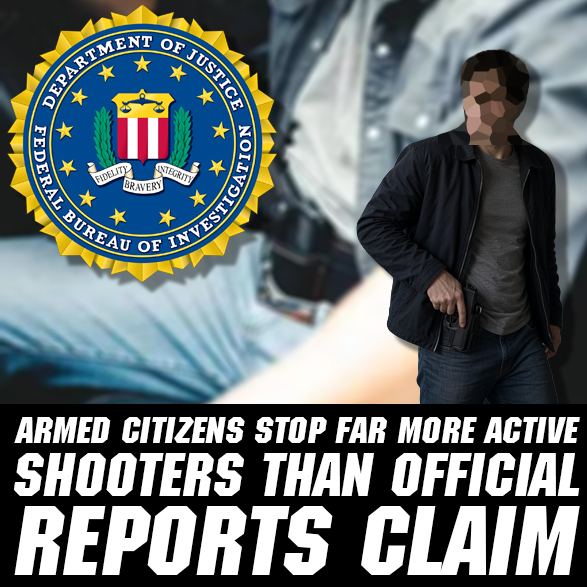
A new review from the Crime Prevention Research Center says those headlines are built on incomplete numbers. From 2014 through 2025, the FBI logged 408 active shooter incidents and credited armed civilians with stopping just 16 of them — about 3.9 percent. The CPRC, led by John Lott, identified 615 incidents that fit the same definition and found armed citizens stopped 225 of them. That is 36.6 percent. They left out another 35 cases where an armed civilian intervened before the attacker ever fired a shot.
Key verified facts:

- FBI active-shooter database (2014–2025): 408 incidents, 16 stopped by armed civilians (~3.9%).
- CPRC count: 615 incidents meeting the same definition, 225 stopped by armed citizens (36.6%). Plus 35 additional cases excluded because the armed civilian intervened before any shot was fired.
- Outside gun-free zones: 52.9% stopped by armed civilians over the period; 58.3% in 2025 specifically.
- Causes of the gap: missed incidents + some misclassifications (e.g., volunteer church security counted as professional security).
- Recent real-world example: October 15, 2026, Silver Rail Elementary (Bend, OR). Armed father Kaylub Giamanco (with a legal pistol) stopped the 16-year-old attacker after a teacher tackled him. Police arrived in ~3 minutes.
The gap is not small. It is nearly ten times larger than the figure most news stories rely on. The Washington Times covered the report on September 10, noting that the discrepancy comes from two places: incidents the FBI missed entirely, and a smaller number it misclassified. Volunteer church security members have been listed as professional security. Cases where a permit holder confronted a shooter and forced him to flee have been left off the “armed civilian” tally because police made the arrest later.
Outside of places that ban civilian carry, the numbers climb further. When the CPRC looked only at locations where law-abiding people were allowed to carry, armed citizens stopped 52.9 percent of the attacks over the twelve-year span. In 2025 alone, the rate hit 58.3 percent — 21 stops out of 36 incidents in places where civilians could legally be armed. That is not a rounding error. It is a different picture of what happens when people who can carry are present.

The recent shooting at Silver Rail Elementary in Bend, Oregon, put the pattern in front of a national audience. On October 15, a 16-year-old former student forced entry into a special education classroom, killing three children and a teacher. A teacher in the room tackled him and fought for the shotgun. A father of two students at the school, Kaylub Giamanco, who was nearby on his lunch break and had a legal .40-caliber pistol in his vehicle, followed the attacker inside and fatally shot him. Police arrived within about three minutes. Officials credited the teacher and Giamanco with preventing more deaths. The attacker still had dozens of rounds left.
Stories like that one draw coverage. Most of the others do not. Lott has pointed out for years that national outlets tend to treat the dramatic cases as exceptions while the local police reports and shorter news items that document other stops stay local. The CPRC publishes its case list with links so anyone can check the underlying reports. The FBI has not added the missed cases even after they have been flagged.

This does not mean every armed citizen will end an attack, or that police response does not matter. It does mean the claim that these interventions are vanishingly rare rests on a dataset that systematically undercounts them. In gun-free zones the opportunities shrink because the people who might stop an attack are required to leave their firearms outside. Where they are not, the data shows they stop a substantial share of attacks — and often do so before the body count climbs.
The numbers come from public records, police statements, and news reports that anyone can read. The CPRC’s full write-up and supporting files are posted on their site. The Washington Times article lays out the comparison clearly. Both are worth reading if you want to see how the official tally and the expanded count diverge, and what that difference means for how these incidents are discussed.
Prepared people, in places where they are allowed to be armed, have stopped more of these attacks than the most-cited federal figures suggest. That fact sits underneath a lot of the policy arguments, whether or not the headlines catch it.