


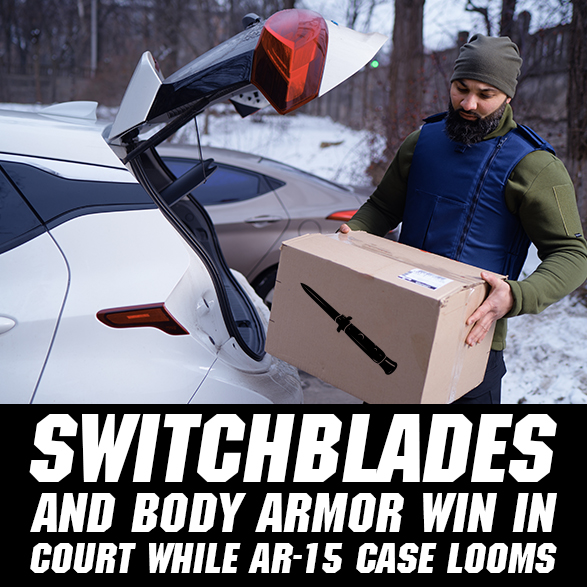
Two federal courts just expanded what counts as protected “arms” under the Second Amendment, and the timing is hard to ignore. On the same day in late October 2026, the Fifth Circuit struck down key parts of the federal Switchblade Act and a Western District of New York judge tossed New York’s ban on civilians buying body armor. Both rulings treat the items as constitutionally protected arms under Heller and Bruen. Gun-rights groups see this as fuel heading into the Supreme Court’s December 2 oral arguments in Viramontes v. Cook County (consolidated with Grant v. Higgins), the big case on whether AR-15-style rifles are protected.
What the Courts Actually Said
The Fifth Circuit, in Knife Rights, Inc. v. Blanche, held that switchblade knives qualify as “Arms” covered by the plain text of the Second Amendment. Chief Judge Jennifer Walker Elrod wrote for a unanimous panel that the 1958 Federal Switchblade Act’s interstate commerce restrictions (15 U.S.C. § 1242) fail the Bruen history-and-tradition test. Millions of automatically opening knives are in common lawful use for defense and everyday tasks. The government could not point to a sufficiently similar historical tradition for the specific ban on introducing, manufacturing, transporting, or distributing them across state lines. The court left the territories provision in place for now, but the core interstate restriction is gone.
On the same day, Judge John L. Sinatra Jr. in Heeter v. James ruled that New York’s first-of-its-kind ban on ordinary civilians purchasing body armor violates the Second Amendment. Heller itself recognized that “arms” include defensive armor—founding-era dictionaries covered “weapons of offense, or armor of defense.” New York tried to call body armor a mere “tactical accessory,” but the court rejected that. The state also failed to show a historical tradition of banning civilians from buying protective gear for self-defense. A 14-day stay keeps the ban enforceable while New York appeals, but the core holding is clear: body armor is an arm.
https://www.foxnews.com/video/6407348878112
Fox News reported that these twin decisions have gun-rights advocates optimistic ahead of the AR-15 arguments. National Association for Gun Rights President Dudley Brown, whose group filed an amicus in Viramontes, told Fox the switchblade and armor cases will effectively be decided by how the Supreme Court rules on AR-15-style rifles. A win for the challengers could shape challenges to magazine limits, automatic knives, body armor, and other defensive equipment.
Why This Matters for the AR-15 Case
Viramontes asks whether the Second and Fourteenth Amendments protect the right to possess AR-15 platform and similar semiautomatic rifles. The Seventh Circuit had treated them as comparable to machine guns and therefore outside Heller’s protection. Second Amendment attorney George Lyon called that reasoning wrong. The lower courts in the knife and armor cases applied the same Heller/Bruen framework: if the item is an arm in common use for lawful purposes, the government must prove a historical analog. They failed.
NRA public affairs director Justin Davis framed the broader fight. Courts are still arguing over what qualifies as an “arm”—suppressors, magazines, stun guns, pepper spray, and now knives and armor. Davis noted the common anti-gun argument that the Second Amendment only covers muskets because that is what existed in 1791. “We don’t apply the First Amendment only to newspapers, books or speech in public forums,” he said. “Social media, texting and phones didn’t exist at that time, either. The world evolves, but the core fundamental rights never change.”
SCOTUSblog confirms oral arguments are set for December 2, 2026. The Solicitor General has backed the challengers, arguing AR-15s are in common use. Estimates of ownership run from 20 million to over 30 million. Cook County and Connecticut defend their bans by claiming the rifles are “unusually dangerous” and not in common use for protected purposes.
What It Means on the Ground
These rulings do not instantly make every restricted item legal nationwide. The switchblade decision is binding in the Fifth Circuit (Texas, Louisiana, Mississippi) and creates a circuit split that could head higher. The body armor decision is stayed and limited to the purchase ban; wearing armor during certain crimes remains restricted. Appeals are likely. Still, the reasoning is the same test the Supreme Court will apply to AR-15s.
For anyone who carries a folding knife for work or defense, or who wants plate carriers and soft armor for training and preparedness, the message is that courts are starting to treat defensive tools as arms rather than optional accessories. The same logic that covers a switchblade or a vest can cover magazines, suppressors, and the rifles themselves if the Court holds that common-use semis fall inside Heller.
Gun-rights groups have already filed amicus briefs in Viramontes. The National Association for Gun Rights and others are watching closely because a clear ruling on what counts as an arm will ripple into challenges against magazine capacity laws, knife bans, and body armor restrictions in other states.
Bottom Line
The Second Amendment fight is no longer just about firearms. Courts are applying Heller and Bruen to knives and protective gear, and the Supreme Court is about to decide whether AR-15-style rifles get the same treatment. December 2 is the date to watch. A ruling that AR-15s are protected arms in common use would make it much harder for governments to treat other common defensive tools as outside the Amendment.