


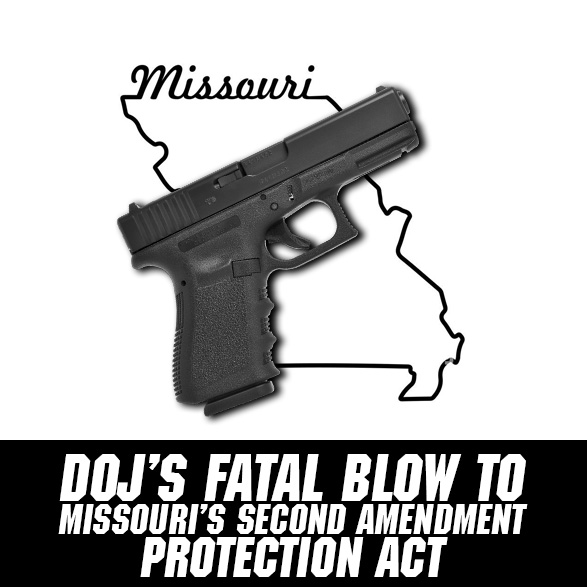
In a major setback for gun rights advocates, Missouri’s bold attempt to shield residents from federal gun laws has been effectively killed by the U.S. Department of Justice. The Second Amendment Preservation Act (SAPA), once hailed as one of the strongest state-level pro-2A measures in the country, is now dead in the water. Here’s what happened, why it matters, and what gun owners should watch for next.
What Was Missouri’s Second Amendment Preservation Act?
Passed by the Missouri legislature in 2021 and signed into law by then-Governor Mike Parson, SAPA declared that all federal gun laws (including the National Firearms Act, Gun Control Act of 1968, and any future federal restrictions) would be unenforceable in Missouri if they violated the Second Amendment.
The law went further than most other “Second Amendment sanctuary” efforts:
- It made it a state crime for federal agents to enforce “unconstitutional” federal gun laws in Missouri.
- It allowed Missouri residents to sue federal officials who tried to enforce those laws.
- It was designed to create a direct legal challenge to federal authority over firearms.
For a time, it looked like Missouri had created a real firewall against Washington’s gun-control agenda.
The DOJ’s Fatal Blow
On December 9, 2025, the U.S. Department of Justice filed a motion to dismiss the last remaining challenge to SAPA in federal court. According to a detailed breakdown from GunsAmerica Digest, the DOJ argued that the law was preempted by federal supremacy under the U.S. Constitution (Article VI) and that Missouri could not nullify federal statutes.
In short: the federal government told Missouri, “Your law doesn’t apply to us.”
The court has now effectively sided with the DOJ, and with no realistic path forward, SAPA is dead. Missouri Attorney General Andrew Bailey had fought to keep the law alive, but the writing was on the wall.
Why This Matters to Every Gun Owner
Even if you don’t live in Missouri, this case has national implications:
- It confirms federal supremacy over state gun laws Courts have repeatedly ruled that states cannot simply declare federal laws invalid. SAPA was one of the most aggressive attempts to do so, and its failure sends a clear message to other states considering similar legislation.
- It weakens “sanctuary state” momentum Dozens of states and hundreds of counties have passed resolutions or laws declaring themselves Second Amendment sanctuaries. Missouri’s experience shows that these measures are largely symbolic unless they’re paired with a successful legal challenge.
- It highlights the limits of state resistance While states can refuse to help enforce federal gun laws (as many do with marijuana laws), they cannot actively block federal agents from doing their jobs. That distinction is now crystal clear.
What Gun Rights Advocates Are Saying
In a recent YouTube video titled “Missouri’s Second Amendment Protection Act Is Dead – Thanks to the DOJ,” firearms attorney and commentator Mark W. Smith (host of the Mark W. Smith Show) called the outcome “disappointing but not surprising.” He emphasized that while SAPA was a bold experiment, it was always a long shot in federal court.
Smith and others are now urging gun owners to shift focus toward:
- Supporting pro-2A candidates in state and federal elections
- Backing constitutional carry and permitless carry expansions
- Pushing for Supreme Court cases that could expand Second Amendment protections (like the ongoing challenges to the ATF’s pistol-brace and “ghost gun” rules)
The Bottom Line
Missouri’s Second Amendment Protection Act was one of the most ambitious attempts to push back against federal gun control. Its collapse shows that the current federal judiciary is unwilling to let states nullify federal law—regardless of how strongly the Second Amendment is worded.
For now, the fight for gun rights remains largely at the ballot box, in state legislatures, and in the Supreme Court. Missouri’s experience is a reminder: symbolic victories are powerful, but they’re not enough to stop federal enforcement.