


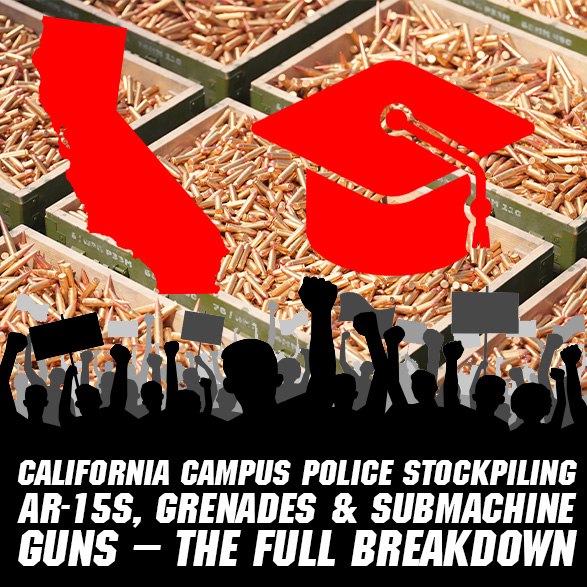
California likes to brand itself as a progressive paradise, but a fresh investigation reveals a different reality on its public college campuses: heavily armed police forces geared up with military-grade hardware. AR-15-style rifles, submachine guns, tear gas grenades, stun grenades, drones, and Long Range Acoustic Devices (LRADs) that can cause permanent hearing damage — these aren’t just sitting in some federal armory. They’re in the hands of campus cops across the UC, CSU, and community college systems.
The spark for all this attention? A deep dive by CalMatters into the 148 public higher ed campuses in the state. What they found wasn’t shocking to anyone who’s followed campus chaos over the past couple years, but the details paint a picture of paramilitary-level preparedness with spotty oversight.
AB 481: The Transparency Law That’s More Like a Suggestion
Back in 2021, Governor Gavin Newsom signed Assembly Bill 481, which was sold as a big win for accountability. Campus police could keep or acquire military equipment only if it was “necessary” for public safety, and they’d have to get board approval, publish annual inventories and use policies, and hold public forums to discuss it all. Sounds reasonable on paper.
In practice? Not so much. The investigation turned up widespread foot-dragging and creative interpretations of the rules. UC Berkeley sat on its inventory for months after approval. Some Cal State campuses claimed their AR-15s were just “standard issue” to dodge reporting, even as one campus’s own docs listed them as specialized firearms. Dozens of community colleges simply didn’t bother filing reports, and the system’s own chancellor’s office admitted it wasn’t tracking compliance.
Public forums? Many were poorly advertised, sparsely attended, or skipped entirely. San Jose State had 33 tear gas grenades and an HK MP5 submachine gun that didn’t align with systemwide policy — stuff the department says it’ll destroy but had been sitting in the armory anyway.
This isn’t abstract policy wonkery. These weapons have real-world uses. UCLA’s LRADs got deployed 71 times in one academic year during crowd control situations tied to protests. Mutual aid agreements let administrators call in outside agencies like the CHP to bypass campus restrictions during the 2024 pro-Palestinian encampment clearances, complete with flashbangs and chemical agents.
The Protest Backdrop — And the Irony
California campuses have a long history of activism, from the Free Speech Movement at Berkeley in the ’60s to more recent flare-ups. The 2024 encampments, clashes over Turning Point USA events, and various labor actions have kept campus police busy.
Critics on the left worry this gear is aimed at silencing dissent. Students and faculty have pushed back against the spending, especially when tuition dollars and budgets are tight. On the flip side, administrators argue it’s about keeping everyone safe amid real threats — fights, disruptions, and escalating tensions.
Here’s where it gets particularly rich for those of us in the 2A community: California has some of the strictest gun control laws in the nation for regular citizens. Assault weapon bans, magazine restrictions, red flag laws, the works. Yet campus cops are sitting on arsenals that would make a lot of private gun owners jealous — often acquired or maintained through federal surplus programs that transfer military gear to law enforcement.
It’s the classic “rules for thee, but not for me” dynamic. While law-abiding Californians jump through hoops for basic firearms, public institutions build up tactical capabilities with minimal real scrutiny. And when protests turn heated — whether pro-Palestine, anti-conservative speakers, or something else — that hardware comes out.
Broader Context: Militarization Trends
This isn’t isolated to California. Nationwide, there’s been a push toward equipping campus police more like SWAT teams, especially post-2020 and amid rising campus unrest. But the Golden State’s version stands out because of the scale and the political theater. Democratic leadership oversees it all while positioning against “authoritarian” threats from elsewhere.
UC and CSU systems face budget shortfalls, yet the investment in this equipment continues. Some campuses are now promising better compliance after the spotlight, and a few are even downsizing certain items. But the underlying trend — treating universities like potential battlegrounds — isn’t reversing.
For Tactical Shit readers who value self-reliance and constitutional rights, this raises practical questions. If campus cops need this level of firepower for “safety,” what does that say about everyday citizens defending themselves or their families? And how does the selective enforcement of transparency laws erode trust in these institutions?
What Needs to Happen
Real transparency would mean consistent, detailed public reporting — not just after journalists start asking questions. Governing boards should actually debate and vote on these acquisitions in open sessions with meaningful input. And maybe, just maybe, apply the same scrutiny to civilian gun ownership that they claim to want for police tools.