

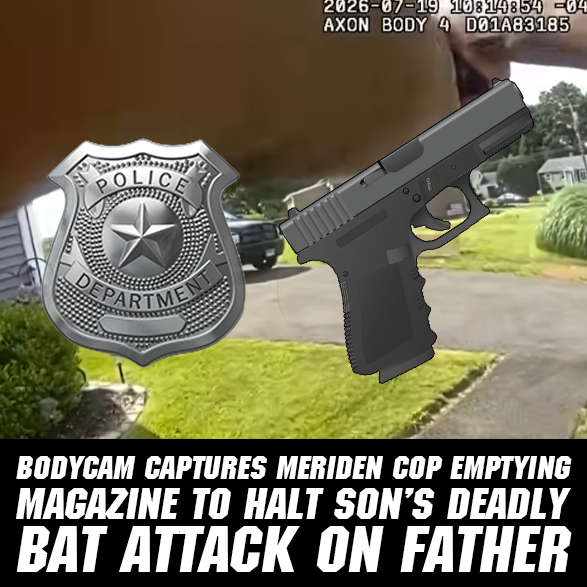
Meriden, Connecticut saw one of those calls that turns a quiet Sunday morning into chaos in seconds. On July 19, 2026, officers responded to reports of domestic violence with a weapon at a home on Sagamore Road. Officer Anthony Offiaeli got there first and walked straight into a nightmare unfolding on the front lawn.
A 38-year-old man, Robert Lee Jenkins III, was mercilessly beating another man with a baseball bat. The victim was already down on the ground, taking blow after blow to the head and body. Bodycam footage released this week captures the horror in raw detail. Offiaeli drew his service weapon and started shouting commands: “Put the fucking bat down! Put it down!” He gave the order at least four times. Jenkins didn’t stop. He kept swinging.
The video shows at least eight solid strikes while the victim lay helpless. Offiaeli closed the distance and fired an initial burst of about five rounds. Jenkins paused for a split second, then raised the bat again and continued the assault. More shots. Still swinging. Only after roughly eleven additional rounds—close to twenty total—did Jenkins finally drop the bat and fall. Backup was just arriving as the 56-second clip ends.
Both men lost their lives that day. The victim, identified by neighbors as Jenkins’ 69-year-old father, Robert Jenkins Jr., died at the scene from blunt force head injuries. The medical examiner ruled it a homicide. Jenkins III was rushed to Hartford Hospital after being hit multiple times in the torso. He was pronounced dead later that evening. His cause of death was also ruled a homicide. Toxicology results are still pending, which could explain why he kept fighting through gunfire.
The Office of the Inspector General, led by Eliot Prescott, released the preliminary report alongside the bodycam and dashcam video. The full investigation, involving state police and the state’s attorney’s office, will determine whether Offiaeli’s use of force was objectively reasonable under Connecticut law. Given the circumstances—an active, ongoing deadly assault on a third party right in front of the officer—it looks like a textbook justification under §53a-22. Officers don’t have the luxury of waiting around when someone is actively beating another person to death.
This kind of call hits hard for anyone who’s spent time in law enforcement or the tactical community. Domestic situations with weapons are unpredictable and often escalate fast. A baseball bat might not sound as scary as a firearm on paper, but when it’s being driven into someone’s skull over and over, it becomes lethal force in real time. Officers train for these split-second decisions, yet the footage still shows how quickly the situation demanded action.
Bodycams like this one provide critical transparency. They cut through the noise and let people see exactly what the officer faced. No speculation needed when the video shows commands ignored and an attack that wouldn’t stop. It also highlights why shot counts sometimes climb higher than civilians expect—adrenaline, movement, a determined threat, and the simple physics of stopping someone who refuses to go down.
The High Round Count and the Reality of Dynamic Shooting
That near-20-round total stands out, and it’s worth breaking down what likely happened with the shots that didn’t immediately stop the threat. In high-stress, rapidly evolving situations like this, misses and non-incapacitating hits are unfortunately common even for well-trained officers. Offiaeli was moving forward while issuing commands, the suspect was actively swinging a bat and shifting position, and the whole encounter happened outdoors on a lawn in a matter of seconds. Factors like adrenaline dump, tunnel vision, and the natural movement of both parties make precision shooting extremely difficult.
From the descriptions in the released footage and preliminary reports, the first string of shots didn’t fully interrupt the attack. Jenkins kept raising the bat and delivering blows. That suggests several of those initial rounds either missed entirely or struck areas that didn’t cause immediate incapacitation—common with handgun rounds against a determined attacker. Subsequent volleys as Offiaeli closed the gap appear to have had better effect, eventually dropping Jenkins after multiple torso hits. The final rounds were likely delivered at closer range as the officer moved in to stop the ongoing deadly threat to the victim on the ground.
No one is perfect under that kind of pressure. Misses happen because real-world gunfights aren’t static range drills. The suspect was in motion, possibly jacked up on adrenaline (or more), and the priority was stopping the bat from continuing to crush the victim’s skull. In those moments, officers are trained to keep shooting until the threat is neutralized—not to pause and assess after every round. The bodycam shows Offiaeli doing exactly that: advancing, communicating, and applying force until the bat dropped.