

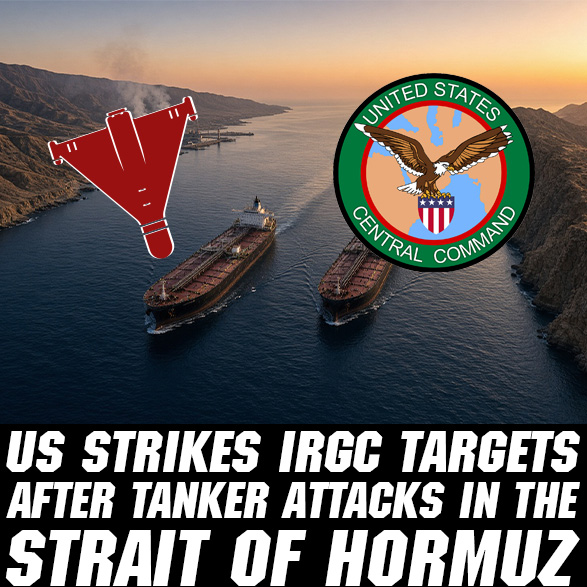
U.S. Central Command said American forces opened a new round of strikes on Islamic Revolutionary Guard Corps targets in Iran at noon Eastern on Tuesday. The command tied the operation to recent attempted attacks on commercial shipping in the Strait of Hormuz and on U.S. personnel in the region. It did not name the sites, the munitions, or the aircraft involved.
That spare language is typical for CENTCOM. The market filled in the rest.
President Donald Trump called the strikes “large and powerful” on Truth Social and framed them as payback for two things: an Iranian effort to seed the strait with sea mines, and a missile attack on a U.S. base in Jordan. He also left a second threat on the table. If Tehran answers, he said, Iran would be hit “at a much harder and higher level,” with a larger attack “waiting in the wings.”
How the weekend broke a month of quiet
Tuesday did not come out of thin air. On Sunday, U.S. forces hit rocket launchers on Iran’s Larak Island after CENTCOM said Iranian units were preparing to fire rockets carrying sea mines into the shipping lanes. Tehran answered with missiles aimed at U.S. sites in Jordan. Those were intercepted. The United Arab Emirates said it brought down an Iranian drone over its waters. It was the first direct exchange of fire between the two sides in roughly a month.
The U.S. Embassy in Qatar put out a security alert on Tuesday warning of “unforeseen escalation,” possible flight cancellations, and airspace closures. That is the kind of notice that usually follows a strike, not one that precedes a tidy ending.
A day earlier, Trump told Fox News, “We’re going to hit them hard. There will be a response.” He did.
Two tankers, still no claim
The commercial piece of this story is messier than the official statements.
Maritime consultants and the United Kingdom Maritime Trade Operations center reported hits on tankers trying to leave the Gulf. Athens-based Marisks said the Saudi-flagged very large crude carrier Sidr, operated by Bahri, took a projectile northeast of Khasab, Oman. The Senegal Prosperity, run by South Korea’s Sinokor, was hit by three objects farther east. UKMTO separately logged a tanker struck by three unknown projectiles while finishing a Hormuz transit. No casualties were reported in the public accounts. No government claimed the shots.
That last point matters. The IRGC has attacked merchant ships since the wider war began on February 28. The United States has also struck or diverted vessels while enforcing a naval blockade of Iranian ports. In a waterway this tight, “unknown projectile” is not a small phrase. It is the difference between a tidy narrative and a shipping desk that has to price risk before anyone owns the incident.
Visible traffic through the strait has already thinned. Shipping data cited this week put daily commodity transits near five vessels, down from a recent 10-day average around 14. Some captains still run dark, AIS off, which makes the official count look cleaner than the water actually is.
Why this strip of water still sets the oil price
The IEA’s latest peacetime baseline is blunt. In 2025, about 20 million barrels a day of crude and products moved through Hormuz — roughly a quarter of seaborne oil trade, most of it headed to Asia. The strait is 29 nautical miles at its narrowest, with inbound and outbound channels only two miles wide. Qatar and the UAE also push a large share of global LNG through the same gap.
There are workarounds. Saudi Arabia’s East-West pipeline and the UAE line to Fujairah can move an estimated 3.5 to 5.5 million barrels a day around the choke point. That is real capacity. It is not a replacement for 20 million. Goldman and others have the Gulf still exporting well below pre-war levels even after months of “dark” crossings and ship-to-ship transfers.
So when two tankers get hit and Washington bombs IRGC sites the next day, crude does what crude does. Reuters had Brent up about 3.8% to $93.93 and WTI up 4.3% to $89.48 during Tuesday trade — a one-week high, and a reminder that the “war premium” never fully left the tape. Diesel has been the quieter problem child, trading near multi-year highs after a steep run over the past two months.
Saxo Bank’s Ole Hansen put it without the adjectives: fresh fighting “raised concerns about prolonged disruptions to energy flows through the Strait of Hormuz.” That is the whole trade in one sentence.
The plan on the president’s desk had a nickname
Monday’s Axios reporting is the piece that makes Tuesday look less like a one-off and more like a method.
Three U.S. officials told the outlet that Trump and senior aides had been weighing a CENTCOM plan for limited, periodic strikes meant to stop Iran from rebuilding radar and missile systems used against ships. Defense Secretary Pete Hegseth backed it and sent it to the White House. Chairman of the Joint Chiefs Gen. Dan Caine was in the loop. One official described the idea as “mow the lawn” — hit the sensors and launchers often enough that tankers, Navy ships, and Air Force aircraft can keep moving.
Last week the White House was leaning against that plan. Sunday’s missiles into Jordan changed the math, or at least the mood. Tuesday’s operation looks a lot like the first cut of that lawn.
Whether it stays limited is the open question. Trump has already advertised a bigger follow-on. A war he once said would last four weeks is now in its seventh month. A Reuters/Ipsos poll released Monday put his approval at 33% and support for the Iran war at 36%, with November’s midterms getting closer, not further away.
None of that tells you what happens on Wednesday. It does tell you why a noon ET strike package is also a political event.