

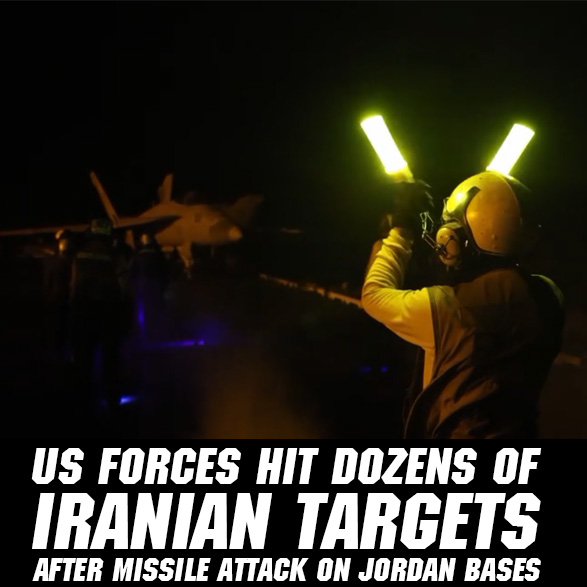
American forces completed a heavy wave of strikes against Iran late Wednesday, hitting dozens of Islamic Revolutionary Guard Corps targets after Tehran tried a surprise ballistic missile attack on US positions in Jordan.
CENTCOM confirmed the operation wrapped up around 10 p.m. ET on July 29. The targets included military command centers, missile and drone facilities, coastal surveillance and defense sites, and maritime capabilities. The goal was straightforward: reduce the threat Iran and its proxies pose to American troops, commercial shipping, and Gulf partners.
More than 50,000 US service members remain in the region, and officials say they are staying locked in.
How We Got Here
The current round of fighting traces back to an Iranian missile barrage on July 28. The IRGC launched multiple ballistic missiles from Iranian territory toward US forces in Jordan, including the Muwaffaq Salti Air Base. American defenses intercepted every one. No US casualties or damage were reported from that salvo.
Earlier in July, three American soldiers were killed in a similar Iranian attack on the same base. That history made the latest attempt feel less like a probe and more like a deliberate test.
President Trump did not mince words. He told Fox News the United States would “hit them hard” and that Iran was “going to get a beating.” In another moment he used stronger language that left little room for interpretation. The strikes that followed were the first direct hits on Iranian soil in several days after a shaky period of reduced fighting.
Iranian Response and Regional Spillover
Tehran did not sit still. Iranian forces launched missiles toward Jordan overnight; all were intercepted. A strike hit a Chinese company building in northern Kuwait, killing one worker. Iran also claimed attacks on US assets in Bahrain.
A drone strike on Egypt’s Damietta Port set two gas-storage tankers on fire—one of them US-owned. Egyptian authorities confirmed a drone caused the fires. Iranian officials denied responsibility and suggested “false flag” operations, pointing fingers at Israel. Saudi Arabia and Qatar both condemned the attacks on Jordan and Kuwait as violations of sovereignty.
Iranian state media reported explosions across southern Iran, including Bandar Abbas, Kish Island, and Qeshm Island. Tehran claimed a couple and their two-year-old child were killed in a strike on Qeshm and that three IRGC members died in Zanjan province. The United States has not confirmed those casualty figures.
The Bigger Picture
This is not a new fight. The broader US-Iran conflict began in late February 2026. A June memorandum of understanding mediated by Pakistan briefly slowed the shooting, but it never fully stuck. Iran has continued testing the Strait of Hormuz, and the United States has enforced a maritime blockade that has redirected dozens of commercial vessels.
Pakistan is still trying to restart talks. A 14-nation maritime coalition led by Saudi Arabia is forming to protect Red Sea and Gulf of Aden shipping from Houthi and related threats. Meanwhile, the Senate killed another War Powers resolution aimed at limiting the president’s authority, keeping the current operational tempo intact.
The pattern is familiar: Iran launches, US defenses hold, American forces answer with precision strikes on the systems that enable the next attack. Each cycle risks pulling in more neighbors—Jordan, Kuwait, Egypt, Iraq—and keeps oil markets and shipping lanes on edge.