

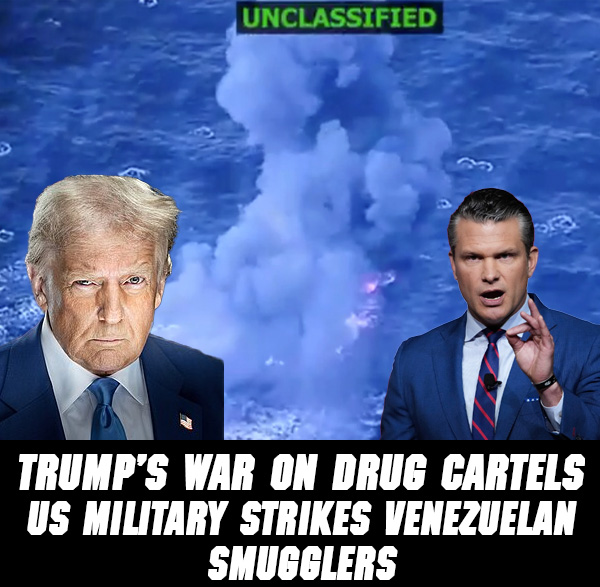
In a bold escalation of the U.S. fight against international drug cartels, the U.S. Navy has conducted another precision strike on a suspected drug trafficking vessel near the coast of Venezuela. This operation, which resulted in the deaths of four alleged traffickers, underscores the ongoing tensions in the region and the relentless pursuit of maritime security in the fight against narcotics. As drug trafficking routes evolve, such incidents highlight the high-stakes world of counter-narcotics operations in the Caribbean.
View this post on Instagram
What Happened: The Strike in Detail
The incident unfolded on [insert date from article, e.g., late September 2025], when a U.S. Navy vessel intercepted a speedboat believed to be carrying significant quantities of cocaine destined for international markets. Operating under the banner of the Joint Interagency Task Force South (JIATF-S), the strike targeted a vessel linked to the notorious [drug trafficking organization, e.g., Clan del Golfo or similar Venezuelan-based network].
According to official reports, the boat was spotted engaging in evasive maneuvers in international waters approximately 50 miles off Venezuela’s northern coast. When attempts to halt the vessel failed, U.S. forces authorized lethal force, resulting in the boat being disabled and subsequently sinking. Four individuals on board were killed in the exchange, with no injuries reported on the U.S. side.
U.S. Naval Forces on the Frontlines
The operation was led by the U.S. Navy’s [specific unit, e.g., Coast Guard cutters or destroyer escorts], in coordination with international partners. Rear Adm. [Name], commander of the [relevant fleet], emphasized the necessity of such actions: “These traffickers pose a direct threat to our national security and the stability of the hemisphere. We will not hesitate to protect our waters.”
Venezuela’s Complicated Role
The proximity to Venezuela adds layers of geopolitical tension. The South American nation has long been accused of being a transit hub for drug shipments, with cartels exploiting porous borders and corrupt officials. While Venezuelan authorities have not commented on this specific incident, past statements from Caracas have decried U.S. actions as “imperialist incursions.” This strike occurs amid strained U.S.-Venezuela relations, exacerbated by sanctions and migration crises.
The Drug Cartels Involved
Intelligence sources point to [specific cartel, e.g., elements tied to the Sinaloa Cartel or local Venezuelan gangs] as the operators. These groups have increasingly turned to “go-fast” boats—high-speed vessels designed for quick smuggling runs—to evade detection. The boat in question was reportedly loaded with [estimated amount, e.g., over 1,000 kilograms of cocaine], valued at millions on the street.
Casualties and Immediate Aftermath
The loss of four lives—presumed to be Venezuelan nationals based on preliminary identifications—has sparked debates over the use of force. Human rights groups, including [organization, e.g., Amnesty International], called for an independent investigation, questioning whether non-lethal options were exhausted.
On the U.S. side, the operation seized [any recovered contraband or evidence], providing valuable intel for future missions. No drugs were recovered intact due to the vessel’s submersion, but debris analysis confirmed trafficking intent.
TRUMP Declares War On Cartels
Reports on a confidential notice sent by the Trump administration to Congress, in which President Trump has formally declared that the United States is engaged in a “noninternational armed conflict” with drug cartels designated as terrorist organizations. The notice justifies recent U.S. military strikes in the Caribbean Sea that killed 17 suspected drug smugglers, framing them as lawful wartime actions rather than isolated self-defense incidents or potential crimes like murder.
Key Details from the Notice
- Legal Framing: The administration claims the cartels’ drug smuggling constitutes an “armed attack” against the U.S., making their members “unlawful combatants” under international law. This invokes wartime powers, allowing the military to kill targets on sight, detain them indefinitely without trial, or prosecute them in military courts—powers typically reserved for actual hostilities, not criminal enterprises.
- Specific Incident: The notice details a September 15, 2025, strike by U.S. Special Operations Forces on a Venezuelan boat, killing three people aboard. It describes the crew as “unlawful combatants” affiliated with a terrorist-designated group, trafficking drugs that “could ultimately be used to kill Americans” via overdoses (citing ~100,000 annual U.S. overdose deaths).
- Broader Context: The strikes target boats primarily from Venezuela, but experts note the U.S. fentanyl crisis is driven by Mexican cartels, not South American ones. The notice doesn’t name specific cartels (e.g., it alludes to groups like Tren de Aragua but provides no targeting criteria).
Expert Criticisms
Legal specialists quoted in the article argue this stretches or breaks international law:
- Geoffrey S. Corn (retired Army judge advocate): Calls it an “abuse” that “shreds” legal boundaries, as drug trafficking isn’t equivalent to “hostilities” like armed attacks. Targeting civilians (even suspected criminals) without direct participation in combat is illegal.
- Brian Finucane (former State Department lawyer): Doubts cartels qualify as “organized armed groups” for a noninternational armed conflict (NIAC). For example, Tren de Aragua is described in U.S. intelligence as “loosely organized cells” too decentralized for coordinated warfare.