


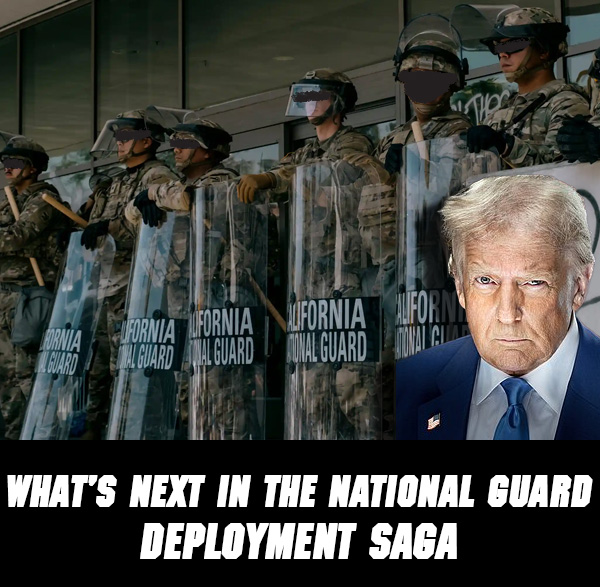
President Donald Trump’s administration has pushed forward with controversial National Guard deployments to quell protests and enforce immigration policies. From Portland’s streets to Chicago’s neighborhoods, federal moves are igniting legal battles, fiery rhetoric, and accusations of overreach. As courts step in and governors fight back, this clash raises urgent questions: Is the president weaponizing the military against his own citizens? Let’s break down the latest developments in the National Guard deployment controversy.
What Sparked the National Guard Deployment Clash?
The Trump administration’s decision to deploy hundreds of National Guard troops to Democratic strongholds like Oregon, California, Illinois, and even Texas cities marks a bold federal intervention. At the heart of the dispute is Portland, Oregon, where nightly protests against Immigration and Customs Enforcement (ICE) facilities have turned into flashpoints. Federal agents and local police have clashed with demonstrators, drawing national attention.
On Saturday, a federal court issued an emergency order blocking Trump’s initial call-up of 200 Oregon National Guard troops, deeming it an unlawful overstep of presidential authority. Undeterred, the administration rerouted troops from California and Texas to hotspots including Chicago, aiming to bolster immigration enforcement amid what officials describe as “domestic threats.”
Court Blocks Deployment: A Win for States, But Appeals Loom
Late Sunday, U.S. District Judge Karin Immergut—a Trump appointee—delivered a stinging rebuke, halting the cross-state troop movements in a ruling that called them “in direct contravention” of her prior order. Oregon Attorney General Dan Rayfield hailed the decision as a stand for the rule of law, posting on social media: “The president doesn’t understand that when the court says no, the court means no, and that is not an indication for negotiation.”
Rayfield’s office, alongside Oregon state leaders, is bracing for an appeal. An appeals court could issue a decision as early as Monday, potentially sending shockwaves through the administration’s strategy. For now, the ruling underscores a key legal tension: Under the Posse Comitatus Act, federalizing state National Guard units without gubernatorial consent is heavily restricted, especially for domestic law enforcement.
California Gov. Gavin Newsom wasted no time joining the fray, signing onto Oregon’s lawsuit to block the California-sourced troops. “This is not federalism; it’s federal fiat,” Newsom stated in a press release, emphasizing states’ rights in a post-2024 election landscape.
White House Fights Back: “Domestic Terrorism” and Immigration Enforcement
The administration isn’t backing down. White House Deputy Chief of Staff Stephen Miller fired off a blistering response on X (formerly Twitter), labeling the judicial block as “one of the most egregious and thunderous violations of constitutional order we have ever seen.” He framed the deployments as essential to counter “a violent armed resistance designed to incapacitate the essential operations of the duly-elected federal government, by force.”
Miller doubled down on the narrative of “domestic terrorism,” vowing “the full and unrestricted enforcement of federal immigration law in all fifty states.” This rhetoric aligns with Trump’s broader 2025 agenda, which prioritizes mass deportations and crackdowns on sanctuary cities—policies that have reignited protests in blue states.
Why This Matters: Broader Implications for Federal-State Relations
This National Guard standoff isn’t just about troops on the ground—it’s a litmus test for power in Trump’s second term. Democratic governors argue the deployments erode state sovereignty and risk escalating peaceful protests into full-blown confrontations. Republicans, meanwhile, see it as necessary muscle against what they call lawless anarchy.
Key takeaways:
- Legal Precedent: If appeals courts uphold the block, it could limit Trump’s Insurrection Act invocations, a tool he’s eyed for border security.
- Political Fallout: With midterms looming in 2026, this divide could galvanize voters on both sides—Democrats rallying around “defend democracy,” Republicans around “law and order.”
- Immigration Flashpoint: Portland’s ICE facility, patrolled by federal agents amid ongoing demonstrations (as captured in recent Getty Images), symbolizes the human cost of these policies.
As the appeals process unfolds, all eyes are on whether this clash will fizzle in courtrooms or flare into street-level chaos. One thing’s clear: In 2025 America, the line between federal protection and overreach is blurrier than ever.