

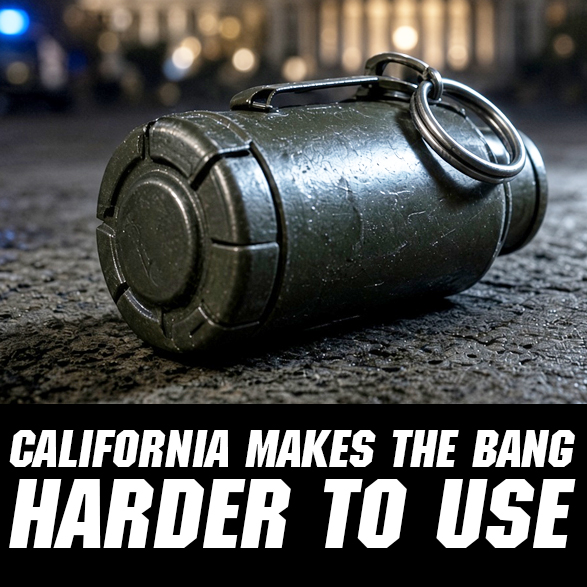
California did not ban flash-bangs on September 29. Gavin Newsom signed a narrower bill, and the press still sold it as a crackdown on “military-style weapons.” SB 937 is Chapter 754 of the 2026 statutes. Senator Lena Gonzalez of Long Beach wrote it. Scott Wiener coauthored it. It takes effect January 1, 2027.
Read the statute, not the headline. Sacramento folded noise-flash diversionary devices into the same protest rules it already hung on rubber bullets and tear gas, then walled flash-bangs and explosive door charges off from most immigration enforcement. The slogan is doing more work than the text.
The label is the tell
Gonzalez’s office keeps calling these military-style weapons. A flash-bang is a less-lethal bang and a flash. Entry teams use them so they do not have to shoot somebody in a dark room. That is the whole point of the tool. California’s own law-enforcement groups said so on the way to the governor’s desk.
The California Police Chiefs Association, the California State Sheriffs’ Association, PORAC, and the California District Attorneys Association opposed the bill. Senator Marie Alvarado-Gil voted no and said the quiet part out loud: these devices exist to end a dangerous problem without going to deadly force. Take the intermediate tool away and the fallback is a firearm. Anybody who has spent time around use-of-force policy already knows that sequence.
The definition in the new Penal Code language is wide on purpose. A flash-bang grenade is any less-than-lethal explosive or pyrotechnic device, thrown or launched, built to stun, distract, make an arrest, or break up a gathering. Blast balls, sting balls, stinger grenades, concussion grenades, stun grenades, and noise-flash diversionary devices are all in. So are versions that also throw chemical agent, projectiles, or shrapnel.
What an officer has to clear before he can use one
SB 937 amends Penal Code sections 13652 and 13652.1 and adds 13652.2. Those sections already told police they could not disperse an assembly, protest, or demonstration with kinetic rounds or chemical agents unless a stack of conditions was met. Flash-bangs now sit in that same stack.
At a crowd, the rules look like this:
- Only a trained officer, with POST crowd-control certification or equivalent crowd-control or SWAT training.
- The use has to be objectively reasonable to stop a threat to life or serious bodily injury, or to bring an objectively dangerous and unlawful situation under control.
- De-escalation has to have been tried and failed, when that attempt is reasonable.
- A warning and time to leave, when reasonable.
- Not aimed at the head, neck, or other vital organs.
- Only a commanding officer on scene can authorize it. Tear gas already worked that way.
- Not used solely for a curfew violation, a verbal threat, or somebody refusing an order.
- Targeted and proportional, with bystander protection and medical aid when it is safe to give it.
Every crowd-control use has to be posted on the agency site within 60 days, 90 with just cause, and reported into the Department of Justice use-of-force database.
“Law enforcement agency” is written wide: state, local, special district, and federal agencies that employ peace officers. Sacramento is reaching for federal teams inside California, not just LAPD and the sheriff.
Immigration enforcement is the real ban
Crowd control still has an exception. Immigration work mostly does not.
Flash-bangs and explosive breaching charges cannot be used for immigration enforcement unless the operation is a joint task force under Government Code 7284.4(g), or it fits an existing Values Act exception in 7284.6. That is the fact pattern Gonzalez campaigned on. Federal agents used an explosive charge on a Huntington Park home while a mother and two young children were inside. Her office also cited a 2025 Los Angeles protest in which a bystander, later named as Sergio Espejo, lost a finger after being hit by a flash-bang.
Those are bad outcomes. They are also the cases a legislature reaches for when it wants a statewide rule. A barricaded suspect, a high-risk warrant, and an ordinary SWAT callout are not what this section targets. The prohibition is purpose-based. If the purpose is immigration enforcement, the tool is off the table outside those narrow exceptions.
How it got there
Introduced January 29, 2026. The Assembly passed it 57–18 on August 25. The Senate concurred 29–11 the next day. Newsom signed it September 29 inside a larger immigration package the same day: shock-glove limits, detention-facility rules, and a bar on some former ICE officers becoming California peace officers.
This is the California pattern, not a one-off. AB 48 already clamped kinetic rounds and chemical agents at protests. SB 937 extends the clamp to the bang. The next bill will find the next tool. People who follow this state’s gun laws have watched the same method on rifles, magazines, and braces: pick an incident, pick a label, write the restriction, dare the courts to unwind it.
What it does not do
It does not outlaw civilian flash-bangs. Civilians were already shut out. Under federal law those devices are destructive devices for almost everyone who is not law enforcement or a licensed manufacturer. If you are reading this as a gun owner, SB 937 is not your Form 1 problem.
It also does not erase the crowd-control path. A commander on scene can still authorize one if the threat standard is met. It does not, on its face, ban noise-flash devices on a barricade or a narcotics warrant that is not immigration enforcement.
The fight that matters is the federal one. California can discipline its own officers and pull state certifications. Whether a state penal statute binds an ICE or HSI team on a federal operation is a preemption question this bill does not settle. The joint-task-force language is the escape hatch written into the text. Expect it to get used, and expect Sacramento to call that a loophole the minute it is.
For the 2A reader, the useful point is simpler than the press release. California just made it harder for police to use the less-lethal option, wrapped the change in military-style language, and signed it beside a stack of immigration bills. The firearm did not get safer. The politician got a headline.