

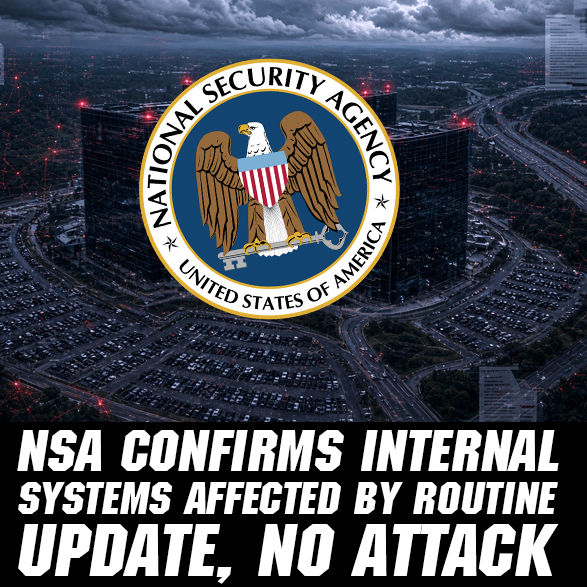

The National Security Agency’s main classified internal communications network hit a snag on Tuesday. NSANet, the system NSA employees use to move secret and top-secret material around Fort Meade, experienced what the agency itself called a “temporary degradation” during scheduled routine maintenance. Mission-critical capabilities stayed up, according to the official line, and nobody is pointing to a cyberattack.
CNN broke the story first, citing six people familiar with the situation. The network was down enough that the agency staggered arrival times for personnel at its Maryland headquarters and put out a “code yellow” on the employee voicemail line—the second-highest alert level in their three-tier system. Non-emergency staff got told to show up later so they wouldn’t all try logging on at once. Restoration was still ongoing as of early afternoon, one source told the network.
The NSA statement is short and to the point: “The National Security Agency experienced temporary degradation during scheduled routine maintenance. While some internal systems were affected, mission-critical capabilities remain fully operational and our ability to defend national security continues. NSA’s infrastructure is designed with multiple layers of redundancy to maintain operations during planned maintenance or unexpected events.”

Wall Street Journal reporting adds that the agency was simply patching software when things went offline. Temporary, no attack evidence. Forbes and others carried the same confirmation. White House spokesperson Lauren Bis told Newsmax there was “no evidence that this was a cyberattack” and “no crisis” for regular Americans to worry about.
A former senior NSA official described NSANet as “more of a network of networks,” so a total blackout is unlikely given the built-in backups. Highest-priority work would still get done, the person said. It could slow analysis and reporting, but it shouldn’t stop urgent intelligence from reaching President Trump. He’s currently in the Philippines and heading to China for meetings with Xi Jinping and Vladimir Putin. Multiple redundancies and backup networks exist for that kind of traffic. Five Eyes intelligence sharing with the UK, Canada, Australia, and New Zealand also stayed unaffected, sources said.
This isn’t the first time the NSA’s internal systems have hiccuped. Back in 2000 a tech failure knocked computers offline for nearly three days and interrupted processing at Fort Meade.
The timing sits right in the middle of a string of other tech failures. The FAA grounded departing flights nationwide last week after a single router issue in Arkansas. Microsoft’s Outlook and Teams went down. Chase Bank customers couldn’t access accounts. United Airlines hit its own system snag. Homeland Security Secretary Markwayne Mullin told CNBC there was “complete certainty” the country wasn’t under an active cyberattack; instead, he blamed new technology getting piled on top of old systems until something breaks. Trump, while traveling, basically shrugged it off as the cost of being big and powerful.
For anyone who follows these things, the practical takeaway is simple. Even the agency that runs some of the most sophisticated signals intelligence and cybersecurity work on the planet still has to deal with patching windows, staggered logins, and the reality that critical infrastructure can go sideways during routine work. Redundancy is the whole point of these systems. The fact that mission-critical paths stayed open is what matters. The fact that a classified internal network needed staggered arrivals and a code yellow while the President is overseas is a reminder that nothing is as seamless as the public statements make it sound.
Keep an eye on whether the NSA releases more detail on exactly which systems were hit and how long full restoration took. Until then, the official position is that the nation’s ability to defend itself continued without interruption.
