


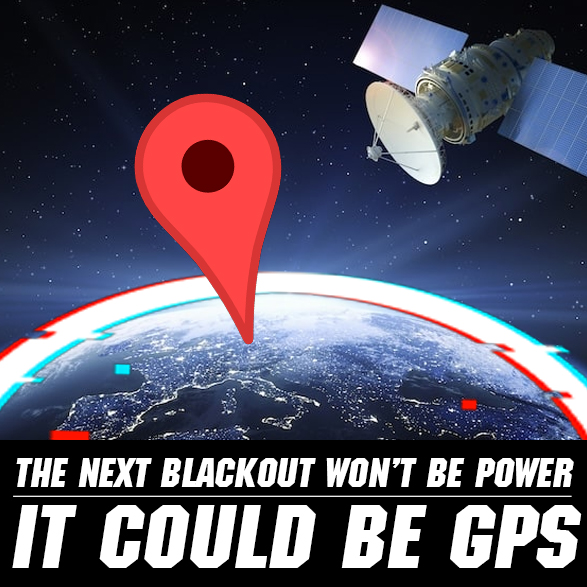
The GPS system, originally developed for military precision, now underpins virtually every facet of modern American life—from smartphone navigation and ATM transactions to commercial aviation, maritime shipping, financial markets, and emergency services. As we mark over 30 years since it reached full operational capacity, this once-invulnerable technology faces a growing existential threat: deliberate disruption through jamming and spoofing by adversaries.
In a compelling opinion piece published in The Hill, retired four-star Adm. Michael S. Rogers (former commander of U.S. Cyber Command and director of the National Security Agency) warns that adversaries are actively waging electronic warfare against GPS signals. Russia has been documented spoofing and jamming across Eastern Europe and the Baltic region, while both Russia and China engage in aggressive satellite shadowing and orbital “dogfighting” maneuvers. These tactics, once rare, are now battle-tested tools in ongoing conflicts.
The fallout extends far beyond military domains. Daily navigational disruptions plague the Baltic, Black Sea, Middle East, and Eastern Mediterranean, affecting civilian air, land, and sea travel. Incidents have surged since Russia’s invasion of Ukraine in 2022, with spoofing and jamming becoming near-constant in conflict zones and spilling over into broader areas. Recent reports highlight thousands of affected flights monthly, vessels “teleporting” to false locations (e.g., ships appearing inland), and even high-profile cases like GPS interference on European leaders’ aircraft.
Closer to home, similar vulnerabilities have surfaced in the U.S. Interference near major airports like Dallas and Denver has disrupted hundreds of flights (nearly 350 in documented cases), demonstrating how fragile reliance on satellite-based positioning, navigation, and timing (PNT) truly is—even when not directly state-sponsored.
The High Cost of Inaction
A sustained, coordinated GPS outage wouldn’t unfold over days; it could cascade within minutes. Aviation systems fail, financial timestamps desync (critical for high-frequency trading), emergency responders lose location accuracy, supply chains halt, and power grids reliant on precise timing falter.
Rogers cites the 2022 Tonga volcanic eruption as a stark real-world parallel: A severed undersea cable combined with blocked satellite signals caused an immediate societal blackout. ATMs stopped dispensing cash (banks couldn’t verify balances), cargo operations froze, produce rotted on farms, and pharmacies couldn’t process prescriptions. Recovery took months.
Experts estimate a major U.S. GPS disruption could cost the economy upwards of $1.6 billion per day. In an era of rising geopolitical tensions, it’s no longer a question of if but when such an event occurs—whether from hostile jamming/spoofing, cyberattacks, or natural phenomena.
Why We’re Vulnerable—and Why Alternatives Exist
GPS signals are weak by design (originating from satellites 12,000+ miles away), making them easy to overpower with inexpensive jammers or counterfeit spoofers. Adversaries exploit this asymmetry: Low-cost disruptions yield outsized strategic gains.
The good news? Resilient solutions are within reach without replacing GPS entirely. Rogers emphasizes a layered, multi-source approach to PNT resilience:
- Terrestrial backups — Leveraging existing 5G cell tower infrastructure to deliver independent timing and location signals. These ground-based systems are scalable, cost-effective, and integrate seamlessly into telecom networks already deployed nationwide.
- Complementary technologies — Including low-Earth-orbit satellite signals, inertial sensors, advanced antennas, and other non-GNSS sources for redundancy.
- Military-grade enhancements — Such as M-code encrypted signals, though these primarily benefit defense users.
American companies are pioneering these 5G-powered and hybrid PNT backups. The Federal Communications Commission (FCC) has initiated inquiries into strengthening national PNT, including ground-based alternatives. Industry groups like the GPS Innovation Alliance have urged coordinated federal action to deter interference, modernize regulations, and accelerate deployment.
Yet the primary barrier remains policy and bureaucracy, not technology. Speed is essential—delays compound risks as threats accelerate.
Time to Build Resilience
America must shift from awareness to urgent execution. Prioritize layered defenses: Blend space-based GPS with robust terrestrial and alternative sources. Invest in detection (e.g., distributed smartphone sensor networks for real-time jamming identification) and deterrence through diplomacy and public statements.
As Adm. Rogers concludes: “The threats are real; the technology is ready; and the cost of inaction grows by the day.” Our critical infrastructure, economy, and national security depend on acting now to ensure PNT remains reliable—no matter the challenge.