

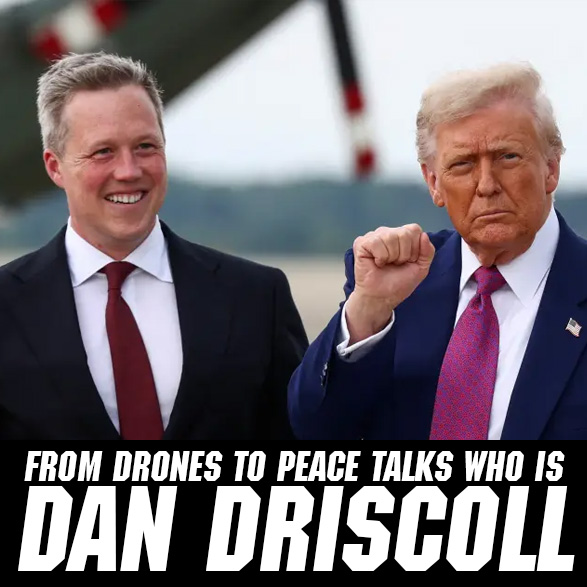
In the high-stakes world of international diplomacy, where seasoned envoys and career diplomats typically hold the reins, an unexpected figure has emerged as the point man for one of the most pressing global conflicts: Dan Driscoll, the 39-year-old U.S. Army Secretary. Dubbed Trump’s “drone guy” for his pioneering push on battlefield AI and unmanned tech, Driscoll’s meteoric rise—from Iraq War veteran to key negotiator in Ukraine-Russia peace talks—has captivated Washington insiders and global observers alike. As the war enters its fourth year, with a leaked U.S.-Russia peace plan sparking outrage and tentative breakthroughs, Driscoll’s unconventional role signals a bold shift in American foreign policy.
Who Is Dan Driscoll? A Quick Profile of the Disruptor at the Helm
Dan Driscoll isn’t your typical diplomat. Born around 1985 and raised with a strong military lineage—his father and grandfather both served—Driscoll graduated from the University of North Carolina at Chapel Hill before enlisting in the U.S. Army in 2007. A standout in Ranger School, he deployed to Iraq in 2009 for a nine-month combat tour, earning accolades like the Army Commendation Medal. Transitioning to civilian life, he earned a Yale Law degree, interned on Capitol Hill’s Veterans’ Affairs Committee, and climbed the ranks in finance as COO of an investment bank in Charlotte, North Carolina.
His entree into Trump’s orbit came via a deep friendship with Vice President JD Vance, forged at Yale Law. The two Iraq vets bonded over shared experiences in the Army and finance, with Vance recruiting Driscoll during a 2024 family vacation in Switzerland for the Trump campaign. Driscoll’s rapid ascent continued: He bought a suit from an outlet mall, Ubers to the Republican National Convention, and was confirmed as Army Secretary on February 25, 2025—sworn in just weeks after Trump’s January inauguration. By April 2025, Trump had tapped him as acting director of the Bureau of Alcohol, Tobacco, Firearms and Explosives (ATF), and he’s since overseen National Guard deployments to U.S. cities.
What sets Driscoll apart? His laser focus on “silicon and software” over “soldiers’ blood and bodies.” In an October 2025 speech, he envisioned every infantryman carrying a drone into battle, powered by AI to outpace human decision-making. Trump himself praised this vision, calling Driscoll a “disruptor and change agent” with a “powerful combination of experiences.” Critics, however, question his credentials: Little in his résumé screams Russia-Ukraine expert, and his 2020 bid for a North Carolina House seat ended in defeat.
The Leaked Peace Plan: A 28-Point Bombshell Ignites Global Tensions
The catalyst for Driscoll’s diplomatic debut was a bombshell leak last week (as of November 25, 2025): a 28-point U.S.-Russia peace framework that stunned Ukraine and its European allies. Drafted in secret, the plan proposed Ukraine ceding territory not currently occupied by Russian forces in exchange for an immediate halt to Moscow’s 33-month invasion—terms widely decried as a “capitulation” rewarding aggression. Ukrainian President Volodymyr Zelenskyy voiced fears on November 22 that it could force Kyiv to “lose dignity or risk losing a key partner.”
This wasn’t Trump’s first swing at brokering peace—he pledged to end the war on “day one” of his presidency—but the leak exposed fractures. Trump’s initial envoy, real estate mogul Steve Witkoff, had laid groundwork, but the document’s exposure prompted a U.S. pivot to damage control. Enter Driscoll: On November 20, he led the most senior Pentagon delegation to Kyiv since Trump’s return, meeting Zelenskyy and delivering the plan in person. The handshake at the U.S. ambassador’s residence was polite, but the subtext was tense—Driscoll bluntly told Ukrainian officials: “This is the reality… Ukraine is at a disadvantage right now. The United States and NATO have a limited ability to reverse the battlefield disadvantage.”
Driscoll’s High-Wire Act: From Geneva to Abu Dhabi
Undeterred by the backlash, Driscoll doubled down. On November 23, he joined Secretary of State Marco Rubio, Witkoff, and Trump’s son-in-law Jared Kushner in Geneva for weekend talks with Ukrainian officials. The result? A refined 19-point framework, trimming concessions while addressing Kyiv’s core concerns. Ukrainian National Security Adviser Rustem Umerov announced a “common understanding” on the essentials, signaling tentative buy-in after Switzerland-side discussions.
By Tuesday, November 25, Driscoll wrapped two days of meetings with Russian delegates in Abu Dhabi—his first direct Kremlin engagement. Sources describe his style as disarming yet unyielding: a “nice, beautiful face” masking a “total killer,” per Trump’s jovial Oval Office quip on September 15, 2025. Trump handpicked him to “shake this up,” betting a military mind might sway Moscow where academics faltered: “Maybe [the Russians] are going to be more willing to be persuaded by someone from the military.”
What’s Next for Ukraine-Russia Peace? Driscoll’s High-Stakes Gamble
As Driscoll preps for Russia this week, the 19-point plan hangs in the balance. Success could cement his legacy, delivering Trump’s promised quick fix and freeing U.S. resources for domestic priorities. Failure risks alienating Kyiv, fracturing NATO, and prolonging a war that’s drained billions in aid.
For Ukraine, the stakes are existential: Land for peace, or fight on amid disadvantages? For Russia, it’s a test of Putin’s red lines. And for America, Driscoll embodies a tech-infused realpolitik—prioritizing innovation and deal-makers over endless entanglements.
In a conflict defined by drones and deadlock, one “adorable” Army Secretary might just rewrite the ending.