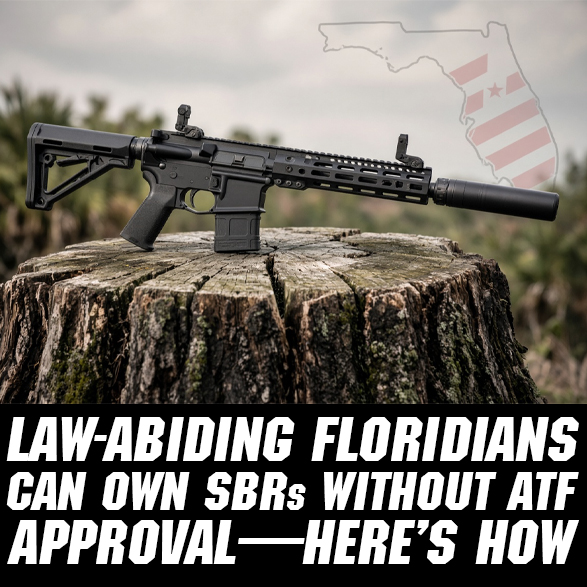

Florida just made it official. On November 6, 2026, Attorney General James Uthmeier told law enforcement and prosecutors across the state that law-abiding residents can possess short-barreled rifles and short-barreled shotguns without an NFA registration, tax stamp, or fear of state prosecution. The memo lands days after the ATF’s October 9 open letter and after a local State Attorney already flagged the same practical reality.
The federal shift started earlier. Congress zeroed out the making and transfer tax on SBRs, SBSs, silencers, and certain “any other weapons” in the One Big Beautiful Bill. A Texas federal court then limited the NFA’s prior-approval and registration scheme in Silencer Shop Foundation v. ATF. ATF followed with nationwide enforcement discretion: it will not require Form 1 or Form 4 approval, will not demand registration in the National Firearms Registration and Transfer Record, and will not treat the absence of those stamps as a federal violation for those items. Machine guns and destructive devices stay fully regulated with the $200 tax intact. The ATF’s own press release and guidance page spell it out.
Florida’s statute created the next question. Section 790.221 bans operable short-barreled rifles, short-barreled shotguns, and machine guns as a second-degree felony. It carves out an exception for firearms “lawfully owned and possessed under provisions of federal law.” For years that exception tracked NFA paperwork. Once ATF stopped enforcing registration, the exception’s meaning became the fight.

State Attorney Brian S. Kramer of the Eighth Judicial Circuit put the issue on paper first. In an October 11 letter to police chiefs, sheriffs, and command staff in his six counties, he wrote that Florida law does not independently require a Form 1, Form 4, tax stamp, or federal registration. He cited the Florida Supreme Court’s Rinzler v. Carson decision and concluded that the mere absence of registration no longer proves unlawful possession under federal law, so it does not establish a violation of the state statute. For suppressors the analysis is simpler—Florida has no separate state ban. Kramer told officers that possession of an SBR, SBS, or suppressor without paperwork should not, by itself, create reasonable suspicion or probable cause for detention, search, or arrest. The Reload covered the letter the day after it circulated.
A Melbourne-based attorney’s analysis from mid-October was more cautious. Stewart Law correctly noted that ATF’s decision is enforcement discretion, not a repeal, and that Florida courts had not yet ruled on whether an unregistered SBR still counts as “lawfully owned and possessed under federal law.” The piece also reminded readers that Form 4473 and NICS checks, prohibited-person rules under the Gun Control Act, and the Form 20 requirement for interstate transport of SBRs and SBSs all remain. That last point still matters if you plan to drive an SBR across a state line.
Uthmeier’s November 6 memorandum settles the statewide posture. He told agencies that every law-abiding Floridian may possess an SBR or SBS without NFA approval, registration, or a tax stamp. Mere possession does not supply reasonable suspicion or probable cause for a search or seizure. Discovery of one during a lawful encounter does not, standing alone, justify seizing it as evidence under the plain-view doctrine. His office will not defend a conviction on appeal when the only issue is the lack of NFA paperwork. He also noted that Florida’s firearms preemption statute blocks local governments from layering on extra rules. AmmoLand reported the memo the same day, quoting Uthmeier’s statement that the office will always defend the Second Amendment rights of peaceable citizens.
Suppressors ride along more easily. Florida never imposed its own registration scheme on them. Once the federal tax and registration requirement stopped being enforced, the state-law obstacle largely disappeared. The AG memo focuses on SBRs and SBSs because those are the items explicitly addressed in § 790.221; the practical result for silencers is the same.
What has not changed is worth remembering. Prohibited persons are still prohibited. Dealers still run Form 4473 and NICS. Interstate transport of an SBR or SBS still needs an approved Form 20. Machine guns and destructive devices still require the full NFA process and the $200 tax. Special occupational taxes for manufacturers, importers, and dealers continue. And none of this overrides other states’ laws. If you cross into a jurisdiction that still treats unregistered short barrels as contraband, federal non-enforcement will not protect you there.
The AG’s guidance is an interpretation and a direction to law enforcement, not a legislative repeal or a final court judgment. Future administrations could try to restore NFA enforcement; voluntary registration remains available for anyone who wants the paper trail. For now, though, the practical message from both the local State Attorney and the statewide Attorney General is clear: in Florida, law-abiding owners no longer need the old NFA stamp to possess an SBR, SBS, or suppressor.
That opens options for anyone who has been waiting on the paperwork wall to come down. Check current ATF FAQs before any interstate trip, confirm your own status under the Gun Control Act, and keep an eye on how other states handle their mirror statutes. Florida just became one of the clearer places to own the short-barreled guns the ATF has decided not to chase.