


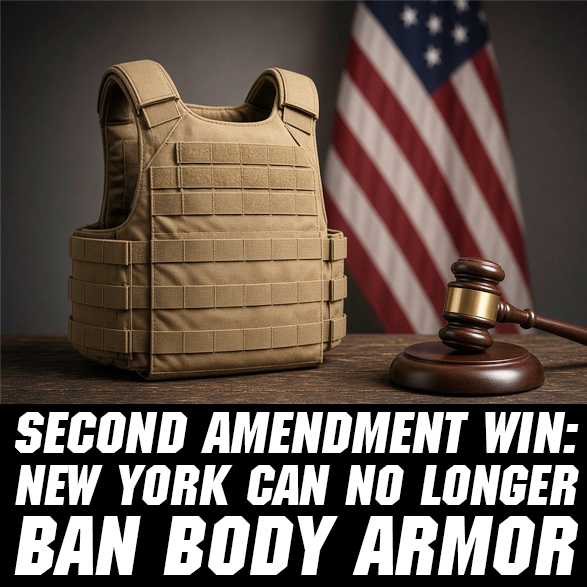
A federal judge just punched a big hole in New York’s gun control playbook. On October 21, 2026, U.S. District Judge John L. Sinatra Jr. ruled that the state’s ban on ordinary people buying body armor is unconstitutional. The decision comes out of the Western District of New York and says defensive armor counts as “arms” under the Second Amendment.
The ban started in 2022 right after the Tops supermarket shooting in Buffalo. The shooter, Payton Gendron, had on body armor when he killed 10 people. Governor Kathy Hochul signed the law as part of a bigger gun package, making New York the first state to block civilians from buying the gear unless they worked in an “eligible profession” like police or the military. Buy it without that status and you were looking at a Class A misdemeanor the first time, and a Class E felony after that. Sellers couldn’t hand it over to regular folks either.
Two New Yorkers, Benjamin Heeter and Joseph Wurtenberg, along with the Firearms Policy Coalition, sued. They said they wanted the armor for lawful self-defense but stayed away because of the threat of arrest and prosecution. The case is Heeter v. James. Judge Sinatra, a Trump appointee, granted their motion for summary judgment in a 47-page opinion.
He leaned hard on the Supreme Court’s Bruen test from 2022. Under that standard, once something falls under the plain text of the Second Amendment, the state has to show the restriction matches the country’s historical tradition of arms regulation. Sinatra pointed out that founding-era dictionaries treated “arms” as including both weapons and “armour of defence.” Body armor isn’t some brand-new invention either. Forms of it have been around a long time, and modern versions are common for lawful use. The state never produced a solid historical analog for a total ban on law-abiding people buying it. English laws about wearing armor in public to scare people didn’t cut it. Existing rules already cover wearing it while committing a violent felony with a gun, and that part of the law stays in place.
Sinatra wrote that the ban “categorically violates the right of individuals to keep and bear arms for self-defense.” He ordered the state to stop enforcing the purchase and sale restrictions against ordinary civilians. He did give New York 14 days before the ruling takes effect so they can appeal. Attorney General Letitia James’s office said they are reviewing the decision. Expect the state to head to the Second Circuit.
This lines up with what gun-rights groups have been arguing for years. Firearms Policy Coalition president Brandon Combs called it a humiliating defeat for New York’s approach, noting that the state tried to ban the means of surviving criminal gunfire after already restricting the guns themselves. The ruling doesn’t open the door for criminals to wear armor during felonies—that remains illegal. It simply says regular people who want protection for home, range, or everyday carry shouldn’t be blocked from buying it.
Coverage of the decision has been steady since the ruling dropped. Syracuse.com reported the Buffalo-based decision and the connection to the Tops shooting. Spectrum News noted the 14-day pause and the attorney general’s review. Courthouse News Service highlighted the Bruen analysis and the plaintiffs’ standing. AmmoLand broke down the summary judgment details and the expected appeal. The full 47-page opinion is available for anyone who wants the exact language. A YouTube discussion (Jared Yanis) also covered the ruling shortly after it came down.
For anyone who follows these cases, the practical takeaway is straightforward. The law treated body armor like an accessory that only certain jobs could own. The court said that doesn’t square with the text or history. Whether the Second Circuit keeps the injunction or puts it on hold will decide how soon New Yorkers can walk into a shop or order online without the old restriction. Until then, the stay keeps the ban active for a couple more weeks.
If you’re looking at plate carriers, soft armor, or ballistic plates for training or protection, now is a good time to check what’s available. Tactical Shit has carried a range of body armor and carriers for years, and the inventory is set up for people who want solid gear without the runaround. The ruling doesn’t change the fact that quality armor still has to meet standards and be used responsibly. It does mean one more state-level barrier is on the way out.
The decision is another data point in the post-Bruen world. States keep testing how far they can go with novel restrictions. Courts keep asking for historical support. When the support isn’t there, the restriction falls. New York still has other gun laws on the books, and this one piece is headed for more legal fights. For now, the district court has said ordinary citizens can buy the defensive armor the founders would have recognized as part of the right to keep and bear arms.