
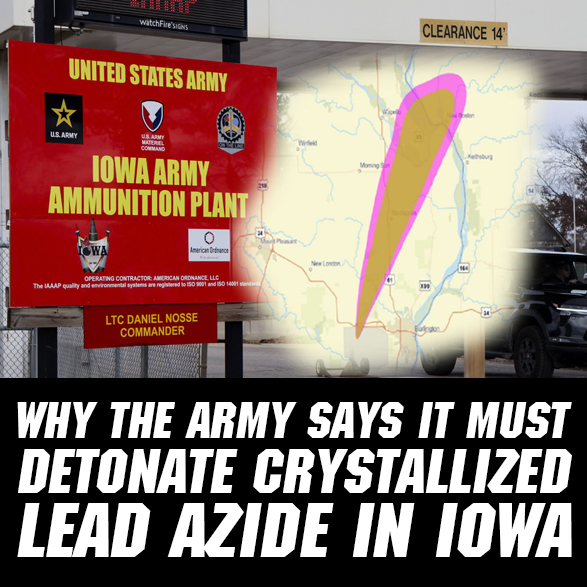

The U.S. Army is moving ahead with a controlled, in-place detonation of more than 9,700 pounds of degraded lead azide at the Iowa Army Ammunition Plant in Middletown on Wednesday, November 25, 2026, at roughly 9:00 a.m. CST. The material sits in about 68 drums inside earth-covered magazines. Routine inspections turned up severe crystallization that has turned a once-manageable primary explosive into something that can go off from friction, vibration, or even a temperature swing.
Lead azide has been a staple in munitions primers and detonators for decades. When it recrystallizes, the crystals form on the outsides of the barrels and across the lids. That locks the containers in place. You cannot move them. You cannot open them. Chemical neutralization gets ruled out for the same reason. The 71st Ordnance Group’s EOD teams are the ones who will handle the blast. Multi-agency reviews that included the EPA, ATF, DTRA, and the Army’s own explosives safety board all landed on the same conclusion: a planned, mitigated detonation is the only realistic way to remove the hazard before an uncontrolled one happens on its own.
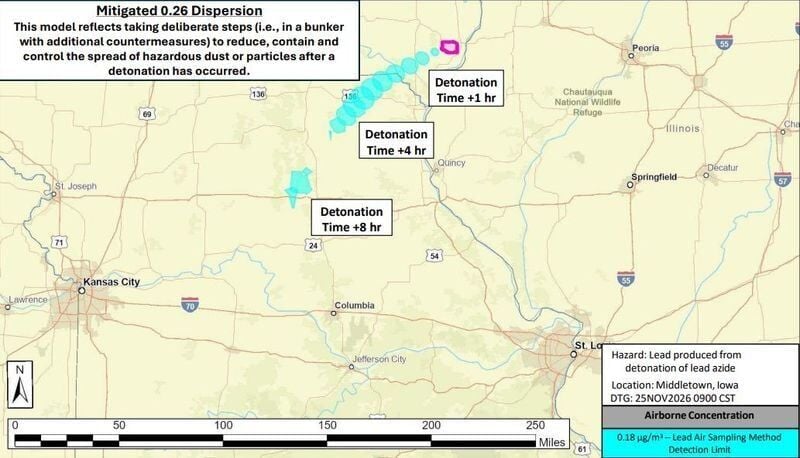
These models assume the planned mitigations (HESCO barriers, water walls, gels, foams, and soil saturation) and use the forecast weather for the 9:00 a.m. CST window. The plume is projected to travel southwest, crossing southeastern Iowa into northern Missouri. Earlier maps for the canceled November 20 date had shown a more northeasterly track; the wind shift changed the path.

Airborne lead dispersion (detectable at the 0.18 µg/m³ sampling method limit; markers at +1 hr, +4 hr, and +8 hr after detonation):
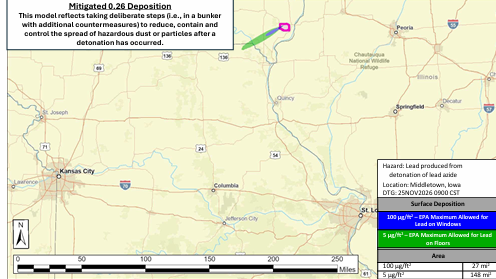
Surface deposition (where lead dust could settle on the ground):

- Higher concentration zone (~100 µg/ft², EPA windowsill comparison level) covers about 27 square miles.
- Broader lower concentration zone (~5 µg/ft², EPA floor comparison level) covers about 148 square miles.
These are forecast models, not measured results. The Army and EPA plan extensive air, soil, and surface sampling before, during, and after the event, with post-detonation maps and cleanup guidance to follow. Official updates are posted on the Army Sustainment Command / IAAAP site and via FEMA alerts. Maps can shift with last-minute weather changes.
Acting Army Secretary Adam Telle put it bluntly at the press conference. A controlled mitigated detonation is far preferable to an uncontrolled one. ATF Director Robert Cekada was even more direct: it is not a question of if an uncontrolled detonation happens, only when. Temperature swings make the situation worse. Freezing weather or a rapid warm-up both increase the odds that the crystals decide to do their job without anyone’s permission.
The engineering package around the site is heavy. Sand-filled HESCO barriers roughly two stories high, soil backfill, aqueous foam blocks, walls of 16,000-gallon water tanks, gel blocks, and high-volume misting systems are all meant to trap debris and knock down airborne particulates before they leave the plant. The goal is to keep as much of the lead oxide dust inside the installation as possible. Models show the remaining plume heading southwest, crossing southeastern Iowa and reaching into northern Missouri. FEMA is recommending that residents inside a five-mile cone southwest of the plant relocate. People out to about 20 miles are advised to stay indoors with windows closed and HVAC systems on recirculation. Sensitive groups—kids under six, pregnant women, anyone with chronic conditions—get the strongest advice to leave the immediate area.
Iowa Governor Kim Reynolds activated the state emergency operations center and declared a disaster emergency for Des Moines, Lee, and Van Buren counties after talking with military leadership, including Secretary of War Pete Hegseth. Up to 100 Iowa National Guard members are on hand for public safety support, not the detonation itself. Missouri has also stood up its operations center. Environmental groups challenged the EPA emergency permit in court. An appeals panel initially stayed the operation, then lifted the stay after finding the groups were unlikely to succeed on the merits. President Trump had publicly paused the plan until the court ruled and Iowa’s incoming governor, Rob Sand, weighed in. Sand deferred to the experts already on the ground. The court clearance and state support cleared the final hurdles.
For anyone who handles ammunition, reloading components, or works around energetic materials, this is a reminder of how quickly storage conditions can turn a stable product into a problem. Lead azide was never meant to sit for years in this state. Crystallization is a known failure mode. The Army’s inability to treat or move the drums once the crystals formed is exactly why magazine design, inventory tracking, and periodic inspection matter. The same principles scale down: keep primers and detonators dry, avoid temperature extremes, and do not ignore signs of degradation.
Cleanup protocols are already planned. The EPA is sampling before, during, and after. If residential soil exceeds the RCRA standard of 200 ppm, remediation happens at government expense. Blast vibration claims will go through the Army Claims Service. Officials are urging residents to follow FEMA and Army channels rather than secondary reports for real-time updates.
The detonation is set for the morning of the day before Thanksgiving. Weather windows and the worsening condition of the material drove the timing. Once it is over, the focus shifts to air and soil monitoring and any necessary cleanup. The consensus across the agencies involved is that waiting longer simply trades a managed risk for a larger uncontrolled one.