


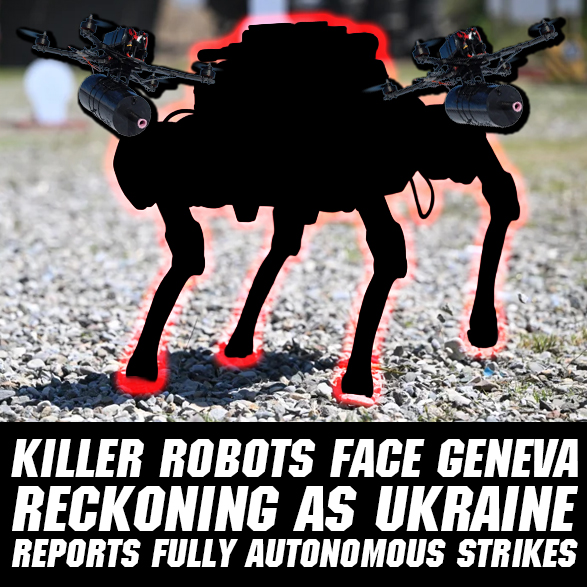
Talks stall before they start. Diplomats from 128 countries gathered in Geneva this week for the seventh review conference of the Convention on Certain Conventional Weapons, and the first order of business was whether to open formal negotiations on lethal autonomous weapons systems—the machines critics call killer robots. The talks barely got off the ground. Russia objected to letting observers, including the European Union and civil-society groups, participate. That single procedural move blocked adoption of the agenda and forced the Swiss conference president into informal consultations that stretched for hours.
This may be the last window. NPR reported that supporters of controls view this once-every-five-years meeting as the last realistic chance to set rules before the technology spreads further. Warfare has moved quickly. AI-assisted systems are already selecting and striking targets in Ukraine and Gaza, though most still keep a human somewhere in the loop. Ukrainian civilians have described being hunted by drones while shopping or walking to school. The next step—systems that finish the engagement without further human input once the signal is jammed—is no longer theoretical.
Leaders call for a binding treaty. UN Secretary-General António Guterres told the conference in a video message that allowing fully autonomous weapons to kill would cross a moral red line. He called for a legally binding instrument that includes clear prohibitions and restrictions. The International Committee of the Red Cross and Pope Leo XIV have issued similar warnings. The Red Cross is particularly concerned that machines will struggle with the chaos of combat: distinguishing a soldier who is still fighting from one who is wounded or trying to surrender. Georgia Haines, a legal adviser with the organization, noted that current technology does not read contextual signals the way a human does, raising the risk of misidentification.
Proliferation and targeting risks draw warnings. Human Rights Watch and other groups argue that cheap, proliferating systems could end up in the hands of non-state actors or repressive regimes. In theory, a swarm could be programmed to target anyone wearing a certain color, carrying a sign, or speaking a particular language. At least 50 states, including Ireland, Italy, Brazil, Mexico, France, and Germany, want a firm timetable for binding rules. Seven countries submitted a formal proposal last month to launch negotiations.
Major powers resist legally binding rules. The United States, Russia, and Israel have indicated they will oppose legally binding controls. Washington has suggested a five-year process aimed at non-binding guidelines instead. AFP noted that Russia’s early procedural objection looked, to campaigners, like an effort to limit scrutiny of its own alleged use of autonomous systems in Ukraine. Last month the UN General Assembly saw 163 states support negotiations; the five no votes came from the United States, Russia, Belarus, Israel, and North Korea. China abstained, maintaining what one analyst called carefully cultivated ambiguity.
Autonomous systems are already in the field. France 24 reported that both Russian and Ukrainian forces have fielded drones capable of identifying and striking pre-programmed targets even after losing contact with their operators. New York Times reporting cited by the outlet suggested that Russian drones that struck a petrol station in Zaporizhzhia in September, killing three people, may have been guided entirely by AI systems. The logic of the battlefield is straightforward: when one side fields jammers, the other builds systems that no longer need a continuous data link for the final approach.
Consensus rules slow any agreement. The Convention requires consensus. That threshold produced a ban on blinding lasers in 1995, but it has stalled progress on other issues. Some states are already discussing a longer or open-ended negotiating track that would let individual countries adopt rules on a voluntary basis. Campaigners call that kicking a dangerous problem down the road. Major powers that already field or are developing these systems argue they cannot afford to limit their options while potential adversaries do not.
Technology is outrunning diplomacy. For people who follow modern combat, the practical reality is that the technology is moving faster than the diplomatic process. Defensive systems that automatically engage incoming missiles have existed for years; the novelty is the shift toward offensive last-mile targeting against human or mixed targets in contested environments. Whether a binding treaty ever materializes, operators and units already have to plan around electronic warfare, spoofing, and systems that continue the mission after the operator’s link drops.