
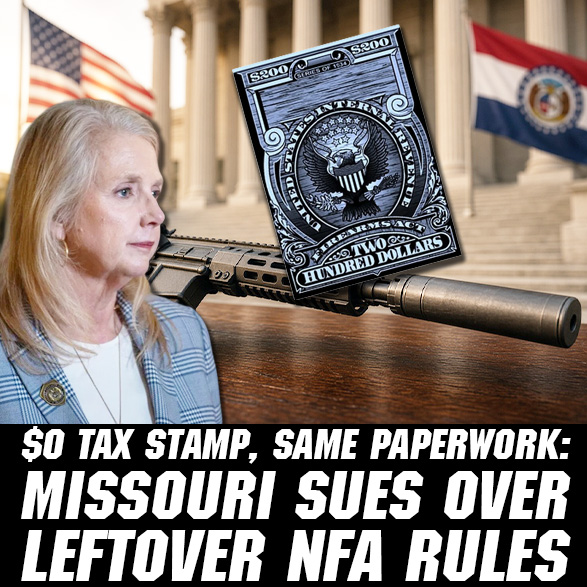
Missouri Attorney General Catherine Hanaway filed a federal lawsuit Tuesday against the Bureau of Alcohol, Tobacco, Firearms and Explosives, asking a St. Louis-area court to stop the government from forcing law-abiding residents to register suppressors and short-barreled rifles.
The case lands in the U.S. District Court for the Eastern District of Missouri. Hanaway is joined by private plaintiff Dave Marshak. The complaint is not a broad attack on every National Firearms Act category. It aims at the leftover paperwork, background-check queue, and criminal penalties that still apply to two items Congress already stripped of their $200 making and transfer taxes.
“Law and order and the Second Amendment go hand in hand,” Hanaway said in her office’s announcement. “A government that respects the Constitution has empowered, law-abiding citizens who can protect themselves and their families. It does not paper over rights with red tape.” She added that ATF’s “heavy-handed restrictions on suppressors threaten lawful firearm use and undermine the rights protected by the Second Amendment.”


What the lawsuit actually asks the court to do
The filing tracks two legal tracks at once.
First, Missouri argues the NFA’s registration scheme for these items no longer sits on a valid congressional power. For decades, the government defended the 1934 law as a tax statute. Applicants paid $200, ATF issued a stamp, and the National Firearms Registration and Transfer Record grew. In the One Big Beautiful Bill Act, signed July 4, 2025, Congress set that making and transfer tax to $0 for suppressors, short-barreled rifles, short-barreled shotguns, and “any other weapons,” effective January 1, 2026. Machine guns and destructive devices kept the $200 tax.
Hanaway’s office says a registration system built to collect a tax that no longer exists cannot be propped up as a tax measure. The state wants a declaration that those leftover rules exceed Congress’s enumerated powers, plus an order blocking ATF and the Justice Department from enforcing them against the covered items.
Second, the complaint treats suppressors and short-barreled rifles as arms protected by the Second Amendment. It leans on District of Columbia v. Heller (2008) and the history-and-tradition test from New York State Rifle & Pistol Association v. Bruen (2022). The state’s position is that there is no founding-era tradition of forcing Americans to register protected arms with a federal bureau, and that both devices are in common use for training, hunting, and self-defense.

That “common use” claim is not abstract. Industry and ATF registry data show suppressor ownership has exploded. NSSF has reported millions of registered suppressors in circulation, with recreational shooting and hunting as the top reasons owners give for buying them. Suppressors are legal to own in 42 states and legal to hunt with in 41. They do not make a rifle silent. They cut muzzle blast enough that a hunter can keep situational awareness without stuffing foam in both ears all day.
Short-barreled rifles sit in a similar spot. A rifle with a barrel under 16 inches, or an overall length under 26 inches, has been an NFA item since 1934. The configuration is popular for home defense and vehicle carry because it is easier to handle in tight spaces. The lawsuit’s point is that popularity and lawful purpose matter under current Supreme Court doctrine in a way they did not when the NFA was written.
Why 1934 still hangs over a $0 tax stamp
Congress passed the National Firearms Act during the gangster era. The $200 tax was the point. In 1934 that sum was a serious barrier, meant to keep machine guns, sawed-off shotguns, and silencers out of ordinary hands without an outright ban that might have been harder to defend. The Supreme Court upheld the statute in United States v. Miller (1939), a short-barreled shotgun case decided with almost no defense presentation. For most of the next 70 years, Miller was treated as the last word.
Heller and Bruen changed the vocabulary. Courts now ask whether a regulation matches the nation’s historical tradition of firearm regulation, not whether a judge thinks it is a good idea. That is the door Missouri is walking through.
The tax-zeroing statute left a strange hybrid. ATF updated its rules to show a $0 remittance. Forms, fingerprints, photographs, wait times, and felony exposure for skipping the process stayed in place. Dealers still talk customers through Form 4 even when no money changes hands with the Treasury. That mismatch is the core of Hanaway’s taxing-power argument, and it is the same mismatch other plaintiffs have already put in front of federal judges.
This is not the only Missouri case, and Texas already moved
Gun-rights groups beat the attorney general to the Eastern District of Missouri. In 2025, individual owners, a St. Louis-area retailer, the NRA, Firearms Policy Coalition, Second Amendment Foundation, and the American Suppressor Association filed Brown v. ATF in the same court, raising overlapping claims after the tax drop.
A separate fight in the Northern District of Texas produced a faster result. On August 5, 2026, Judge James Wesley Hendrix held that NFA registration could not be sustained under the taxing power for the items Congress untaxed. The injunction is party-specific, not a nationwide wipeout of the statute. After a short stay, the Justice Department did not file an appeal within the window the court set, and the order took effect for the plaintiffs in that case.
Hanaway’s suit puts the State of Missouri itself on the caption. That matters for standing arguments and for the scope of any injunction a Missouri judge might later write. It also puts a statewide elected official on record that registration of these two categories, after the tax disappeared, is federal overreach.
None of this automatically lets a buyer walk out of a shop with an unregistered suppressor tomorrow. Machine guns remain heavily restricted. Some states ban suppressors or short-barreled rifles on their own books. Federal Gun Control Act rules on transferring short-barreled rifles from licensed dealers to unlicensed buyers have not all been rewritten. Anyone shopping right now still needs current legal advice for their state and their specific transfer. The Texas order did not rewrite every related statute.
What Missouri owners should watch next
The Eastern District will have to decide whether a $0 tax can still carry a 1934 registration regime, and whether Bruen leaves room for a federal list of who owns hearing-protection devices and compact rifles. Expect the government to argue that registration is a modest public-safety tool independent of revenue, that Miller still speaks to short-barreled long guns, and that suppressors are accessories rather than “arms.” Missouri will answer that a criminal registry with no tax left is not modest, and that millions of lawful owners have already answered the common-use question.
For hunters in Callaway County, range regulars in St. Charles, and anyone who has waited months on an eForm, the practical issue is simpler than the doctrine. They want to know whether a device that muffles a shot enough to save hearing still requires a federal file with their name on it. Hanaway’s lawsuit is the state’s attempt to force that question into a Missouri courtroom instead of leaving it to ATF forms and a $0 stamp that still comes with ten years in prison if you skip the line.