


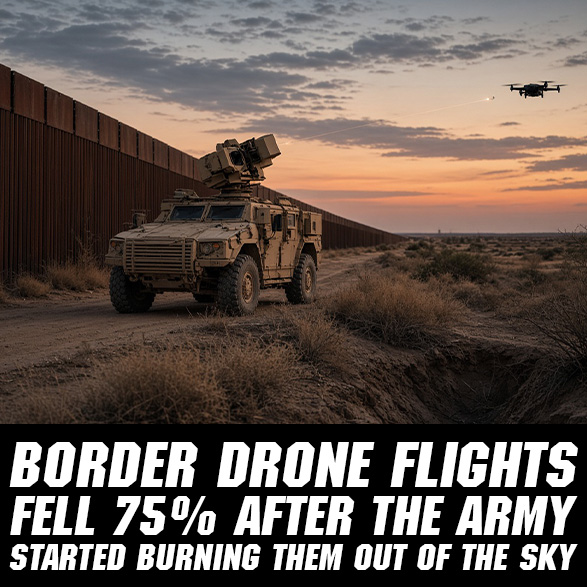
The first three drones came down late on August 25 and into the 26th. Joint Task Force–Southern Border used a vehicle-mounted Army Multipurpose High Energy Laser in the Rio Grande Valley and called the aircraft a physical threat to U.S. troops and Border Patrol. Two weeks later, officers in McAllen told CBS News the probing flights in that stretch of the border had fallen by roughly 75 percent.
That is a sharp drop. It is also a short window. Commanders themselves said cartels may have simply shifted routes. The timing still matters. The dip showed up after the laser started destroying airframes instead of just shoving them back across the river.
Jamming was a revolving door
Most of the year, the military’s answer was electronic. Jam the link, send the quadcopter home, watch it come back the next night. Since January, Joint Task Force–Southern Border says it has stopped about 300 drones it links to cartels. Eleven of those were laser shots across ten days. The rest were the old playbook.
Army Col. Robert Felicio, who commands the 130th Maneuver Enhancement Brigade on the border, put the difference in one sentence. Sending a drone back is temporary. “The game changer is ensuring that that tool can’t be used again against you.”
NORTHCOM’s Gen. Gregory Guillot told Congress in 2024 the southern border was seeing about 1,000 drone incursions a month. Felicio would not give CBS a current daily count for his sector. The point of the laser is not a pretty scoreboard. It is to make surveillance expensive.
Cartels fly small commercial-style quadcopters to map where soldiers and agents are standing. If they know the gap, they run people and dope through it. Lt. Col. Ray Richards, with the Massachusetts National Guard’s 211th Military Police Battalion, argued that a 75 percent cut in that picture is a money hit, not just an air-defense stat. Every flight that does not happen is a route they have to rebuild.
What the beam actually does
CBS watched a live test near the wall. Soldiers launched a small quadcopter over an empty field. Inside the truck, another crew tracked it on a tablet with an Xbox controller. The beam itself did not look like a movie laser. No long glowing line. Just a brief flash where heat hit the airframe. The recovered drone had a chewed-up propeller and no battery. You could still tell what it was.
The system on the border is a version of AeroVironment’s LOCUST, fielded as AMP-HEL. The Army has more than one of them on the line. On September 2 it signed its first production contract for an enduring high-energy laser — about $465 million to AeroVironment. That is the service saying the prototype phase is over.
Cost is the argument Pentagon officers keep repeating. A launcher can run $17 million to $25 million. Each shot is about $3, according to the company. A missile interceptor can cost millions for one bird. Cheap drones were winning that math. A $3 burn changes it.
Navy Adm. Daryl Caudle made the same case in a Washington Post essay this month: lasers are another tool, not a miracle, and the fleet still needs more of them. Rain and vapor cut the beam. Foggy nights on the river are not the weapon’s favorite weather. Nobody at the border is pretending otherwise.
The FAA already had a scare
Directed energy next to civilian airspace is the part that keeps aviation lawyers awake. Earlier this year, drone-related tests and a mix-up that included a party-balloon shoot-down helped trigger a brief FAA shutdown of El Paso’s airport. CBP and the task force also had a friendly-fire episode when troops downed a CBP drone that had not been deconflicted. The Pentagon and the FAA later signed off on use in national airspace. Felicio says crews now check FAA requirements before and after they fire.
They still will not say which side of the line the August shots happened on. That is not a small detail. Mexican President Claudia Sheinbaum has already warned that unilateral U.S. action on Mexican soil would be a sovereignty breach. U.S. officers say they are coordinating with Mexican authorities on tracking. Coordination and a laser over the river are not the same sentence.
Why the threat is not only cameras
Inside Mexico, cartels are not just flying scouts. A DHS-funded report from the National Counterterrorism Innovation, Technology, and Education Center counted 221 armed-drone incidents from 2021 through 2025, with 77 people killed. Those fights are Mexican-on-Mexican so far. Commanders with about 8,000 U.S. troops on the border are watching the hardware migrate. A quadcopter that maps a patrol today can carry a charge tomorrow.
Maj. Gen. Curtis Taylor, who runs the task force, said after the first three shoot-downs that cartels use drones to smuggle people and to spy on U.S. personnel. Layered jammers plus a laser, he said, are the message that hostile surveillance will not get a free pass.
What the 75 percent figure does not prove
Two weeks is not a campaign. Cartels adapt. They can fly lower, fly in weather the beam hates, switch corridors, or put more birds in the air and accept losses. Officials admitted that out loud. The useful fact is narrower: when the Army stopped returning the same airframes and started wrecking them, the local traffic thinned.
The border is also a test range the Pentagon has been looking for. Cheap drones are the problem every combatant command is writing briefings about. A $3 shot that works in Texas is cheaper homework than finding out over a carrier deck.
Lt. Owen Farquer, one of the operators, said the Xbox controller is the easy part. A lot of the soldiers grew up on it. The hard part is rules, weather, airliners, and a river that is both a crime corridor and an international line. The laser does not solve any of that. It just gives the unit on the wall a way to make a scout drone stay down.