


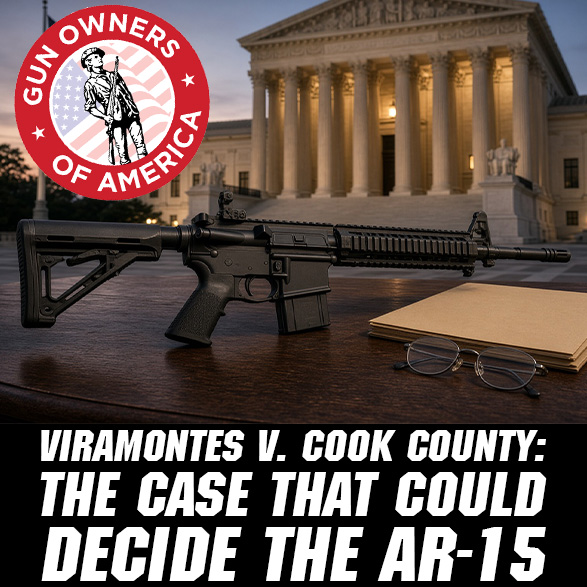
Cook County told residents they cannot own the rifle millions of other Americans already keep at home. On September 4, 2026, Gun Owners of America and Gun Owners Foundation put that fight in front of the Supreme Court, joined by Century Arms, Canik USA, B&T USA, and Fostech.
The brief is filed in Viramontes v. Cook County, docketed as No. 25-238. The Court consolidated it with Grant v. Higgins, the challenge to Connecticut’s similar ban. The question the justices agreed to answer is blunt: whether the Second and Fourteenth Amendments protect possession of AR-15 platform rifles and other commonly owned semiautomatic rifles.
That is not a side issue. It is the issue lower courts have been circling since District of Columbia v. Heller (2008) and New York State Rifle & Pistol Association v. Bruen (2022).
How this case got here
The Court passed on the last clean vehicle. In June 2025 it denied review in Snope v. Brown, the Maryland AR-15 challenge. Justice Clarence Thomas dissented. Justices Samuel Alito and Neil Gorsuch said they would have granted the petition. Justice Brett Kavanaugh wrote that the Fourth Circuit’s decision upholding Maryland’s ban looked “questionable,” and that the Court “should and presumably will address the AR-15 issue soon, in the next Term or two.”
That term arrived. On June 30, 2026, the Court granted Viramontes and Grant. Argument is expected in the October 2026 Term. A decision would likely land by June 2027.
Cutberto Viramontes sued Cook County in 2021 over its ban on certain semiautomatic rifles. The Seventh Circuit had already blessed that approach in Bevis v. City of Naperville, treating the banned guns as close enough to military arms that Heller allowed a prohibition. Connecticut’s law, expanded after Sandy Hook, survived in the Second Circuit on a different theory: the state said it was only targeting “unusually dangerous” guns while leaving other options for self-defense.
GOA’s brief rejects both frames. The government, it argues, cannot ban a firearm that is already in common civilian use because politicians or judges call it “military-style.” The Second Amendment does not split arms into a civilian pile and a soldier pile. The Founders expected citizens to have access to the same class of weapons used by the militia.
The “common use” numbers are no longer fuzzy
Heller said the Second Amendment protects arms “in common use” for lawful purposes. Weapons that are both “dangerous and unusual” can be restricted. Ban states lean hard on the first adjective and try to talk past the second.
The ownership data makes that harder.
Georgetown’s William English published the second wave of the National Firearms Survey in August 2026. It reached a representative sample of more than 51,000 adults. Among gun owners, 25 percent said they currently own an AR-15-type rifle. Another 12.9 percent own a similarly styled semiautomatic rifle. Combined, about 26.4 million adults own at least one gun in those two categories. English estimates roughly 40 million AR-15-type rifles and 20 million similar rifles in private hands.
Industry production lines up in the same neighborhood. NSSF, using ATF manufacturing reports, put about 32 million modern sporting rifles into the U.S. market from 1990 through 2023. Add the last few years of production and the total climbs toward the high 30 millions.
The Supreme Court has already described the rifle in ordinary-consumer terms. In the 2025 decision rejecting Mexico’s lawsuit against U.S. gun makers, Justice Elena Kagan wrote for a unanimous Court that products Mexico targeted — including AR-15s — “are both widely legal and bought by many ordinary consumers,” and that “the AR-15 is the most popular rifle in the country.”
That line was dicta in a different case. Ban opponents are treating it as the Court saying out loud what the market already showed.
What the coalition is actually arguing
This is not only a membership group filing paper. Manufacturers who build and sell the rifles signed on.
Erich Pratt, GOA’s senior vice president, said a win would hit “some of the nation’s most extreme gun control laws,” and that states with assault-weapon bans would “face a reckoning.”
Adam Ruonala of Century Arms and Canik USA called Viramontes a chance for the Court to say commonly owned semiautomatic rifles, including the AR-15 platform, are protected arms. Ridley Key of B&T USA pointed at the features the bans treat as sinister — pistol grips, adjustable stocks, detachable magazines — and said those are the same features that make a rifle easier to control. David Foster of Fostech, which builds rifles in Indiana, put it in plainer terms: these are the rifles Americans already own and use for lawful purposes.
They are not the only ones at the lectern on paper. Rep. Andrew Clyde is leading a House Republican amicus. The NRA filed with the American Suppressor Association and the Independence Institute, walking repeating arms from early multi-shot designs through modern semiautomatics and arguing that today’s rifles are not some sudden break with the historical record.
States on the other side will keep saying lethality and mass-shooting risk justify a ban even if the guns are common. Cook County pressed that point when it asked the Court not to take the case. Prevalence, they argue, should not freeze a legislature in place after manufacturers flood the market. That is the fight the briefs are built for.
Why a ruling would travel
Only a minority of states run a true assault-weapons ban. The usual list is California, Connecticut, Delaware, Hawaii (narrower, focused on assault pistols), Illinois, Maryland, Massachusetts, New Jersey, New York, and Washington, plus the District of Columbia. Some tallies add Colorado’s limited rules and newer statutes in Rhode Island and Virginia. Most of the country does not ban the rifle.
A Supreme Court holding that the AR-15 is a protected arm in common use would not automatically rewrite every statute overnight. It would put those bans on a short clock. Local ordinances like Cook County’s sit on the same theory. So do feature tests that outlaw a rifle for a pistol grip or a collapsing stock while leaving a functionally similar gun legal if it looks “sporting.”
The opposite holding would do the reverse. It would give states a green light to keep treating the country’s most common centerfire rifle as if it sat outside the Amendment.
Heller already refused that move for handguns, even though handguns are used in far more homicides than rifles. The GOA coalition’s point is simple: if a handgun ban in the home was too much, a ban on the most popular rifle in America is not a closer call. It is the same call with a longer barrel.
Oral argument will get into history — militia statutes, 19th-century repeating rifles, whether “dangerous and unusual” can ever describe a gun tens of millions of people already own. The manufacturers in the brief are there to say the Court does not have to guess about common use. They can look at the shop floor and the survey.