


It might not be everyone who knows the same Michael Myers, but a hella lotta people do. He’s the silent, masked serial killer that’s been murdering people since 1978. He’s one of the OG “slashers,” carving innocent people up on Halloween for nearly fifty years across at least a dozen movies. He’s a horror film icon, with an equally iconic (and creepy) leitmotif-style soundtrack and, most recognizably, that Michael Myers mask.
Why are you seeing this now, you ask, since it’s just early September? Glad you asked. Seems like they start putting out Halloween decorations earlier and earlier every year (same with Christmas stuff, for that matter). We just figured we might as well jump on the over-eager, overachiever bandwagon, too. That’ll help us later on if we decide to run any Halloween sales or specials…and perhaps also to spark some interest in this pretty badass Michael Myers shirt. Because, you know, capitalism.
Sorry not sorry.
Anyway, we’re going to look behind that mask. Figuratively. It’s been scaring (or at least entertaining) movie lovers for more than two decades now. We’re going to lay some trivia out for ya well in advance and, to be completely honest, will probably update this and run it again sometime during that last week of October to get your attention again.
But first, a shameless plug. It doesn’t matter whether you’re dealing with domestic criminals, warding off mostly peaceful demonstrators trying to burn your business down, hunting bad guys in man dresses with a penchant for chai boys, or fighting slashers like Mikey Meyers, Jason Voorhees, or Freddy Krueger. The ability to operate in darkness is a huge force multiplier. And that’s why you should…
Michael Myers: Beyond the Mask
Many things to know from the Halloween movie franchise.
Read on. If you know of some other interesting trivia, hit us up in the comments.
1. The Mask’s True Identity.
This is something a lot of people don’t know, but it’s something I’d like to know more about. The iconic, blank-faced mask Michael Myers wears was a store-bought Captain Kirk mask from Star Trek, which was spray-painted white and had its sideburns and eyeholes slightly altered. Who decided on that? It’s funny as hell, and it clearly worked, but you have to wonder, what sort of discussion led them to do that?
2. The ‘Shape’ in the Script.
In the original screenplay, John Carpenter never referred to the character as “Michael Myers” (after he escaped from the sanitarium). Once he was out, he was always simply “The Shape.” This was a deliberate choice to reinforce his inhumanity and lack of emotion. The name was so effective that it’s been used as a credit for the character in later films as well.
3. A Man of Many Faces.
Multiple actors have been the Shape, wearing the mask throughout the franchise (sometimes even within the same film). For instance, the original film alone saw six different people don the mask (including director John Carpenter and producer Debra Hill). Actor Nick Castle, who played Michael Myers for the majority of the original film, is often credited as the original “Shape.”
4. Weapons of Opportunity.
Michael Myers kills a lot of people in a lot of different ways. Anyone who has watched the franchise (especially the first movie) knows that a big kitchen knife is his signature weapon. He’s not limited to that, though! Michael Myers has utilized a horrifying variety of implements to dispatch his victims. He’s used a scalpel, a pitchfork, a scythe, an axe, a hammer, a television set, a tripod leg, and even a syringe. Interestingly, in a scene that was cut from the final film, Michael originally attacked his first victim, his sister Judith, with a simple clothesline before resorting to the kitchen knife. So he’s both a strangler and a slasher. (And a hacker, stabber, hammerer, etc.)
5. The Kill Count is a Matter of Debate.
There is no single kill count for Michael Myers due to the different film timelines. In the original 1978 film alone, he tallied 5 kills, a number he would far surpass later. His official on-screen total varies, but a generally accepted count puts his number of victims at over 150 across all films. In the recent David Gordon Green trilogy, he had his highest kill count ever, with over 50 victims. Some of those kills are a result of people making stupid mistakes (for fuck’s sake, stop walking backwards in the dark when a supernatural killer is hunting you). Many of them are rendered even more gruesome than they might otherwise be due to his various paranormal abilities (like supernatural strength, otherworldly invulnerability to harm, etc.)
6. His Supernatural Strength Has Multiple Origins.
Various movies offer conflicting explanations for his superhuman strength and ability to survive fatal injuries. For example, in the “Cult of Thorn” timeline (films 4-6), a Druid curse gave him his powers. The recent films, however, returned him to John Carpenter’s original vision: a non-supernatural man who is simply the embodiment of pure evil.
7. Navigating the Various Timelines
The Halloween franchise is known for its confusing and often-contradictory timelines, though that doesn’t appear to bother fans. So far, as best I can tell without going full nerdtard, there are four main continuities to follow:
- The Original/Thorn Timeline: The 1978 film and its direct sequels, including Halloween II (1981), Halloween 4: The Return of Michael Myers (1988), Halloween 5: The Revenge of Michael Myers (1989), and Halloween: The Curse of Michael Myers (1995).
- The H20 Timeline: This timeline disregards everything after the 1981 film, picking up the story 20 years later with Halloween H20: 20 Years Later (1998) and its sequel, Halloween: Resurrection (2002).
- The Rob Zombie Remake Timeline: A complete reboot of the franchise that includes Rob Zombie’s Halloween (2007) and Halloween II (2009).
- The David Gordon Green Trilogy: A direct sequel to the 1978 original that ignores all other films in the series. It includes Halloween (2018), Halloween Kills (2021), and Halloween Ends (2022).
8. The Scariest Part is the Eyes.
Some people might argue this, but other than the inexorable way he pursues his victims, it’s the eyes of the Michael Myers mask that give people the worst heebie jeebies. (After all, people say the eyes are the key window to or mirror of the soul; given the dark, expressionless look of that mask, you gotta wonder if he has a soul at all. One particular (presumably intentional) detail that makes the mask so unsettling is that the eye holes were widened to be slightly too large. This creates that haunting, dead stare effect that seemingly leaves nothing but blackness and evil behind the mask. It’s an effective psychological tool. Many other horror flick psychopaths wear masks: Jason from Friday the 13th, Ghostface from Scream, and, of course, the one worn by Leatherface in the earliest slasher flick I know of, 1974’s Texas Chain Saw Massacre. The eyes in particular also reflect a visceral societal fear from that time, a fear in large part created by Charles Manson and his cult’s inexplicable series of murders. (More on that in a bit.)
“What makes Manson’s face so ‘freaky’ is that while his eyes are opened so very widely — the rest of his face (except for his nostrils) are relaxed. It’s difficult to make such an expression without practicing — yet Manson did it all the time. It doesn’t make sense. It confuses us. It feels odd. Normally the mouth is also ‘participating’ with such an extreme eye expression — but not here. Thus, taken on their own, his extremely widely-opened eyes are considerably alarming — but the dramatic incongruity with the rest of his face is what really horrifies us.” ~ Dr. Jack Brown, Body Language Analysis of Charles Manson’s Eyes.
Watch this video to learn how the production designer created the Michael Myers mask to adhere to budget constraints.
9. The Theme Was Composed in Just Days.
The iconic, immediately recognizable theme is remarkably effective, which is impressive given how fast it was thrown together. The Halloween theme is a minimalist piano score, composed by John Carpenter in just a few days. It apparently uses a five-four time signature (I’m not a musician, so I’ll have to take Google’s word for it); whatever you call it, it’s simple and effective, creating a relentless and unnerving sense of dread. At least to me…I was 10 when I saw the first flick, and it scared the hell out of me (though it also started my lifelong appreciation for Jamie Lee Curtis).
10. Myers’ Signature Head Tilt Was an Accident.
Actor Nick Castle’s instincts led him to perform a curious head tilt while looking at a victim in the original film. The moment was not in the script, but John Carpenter loved it so much that it was kept in the movie and became a defining mannerism for the character in later films.
11. His Signature Walk.
Unlike other slasher villains who often sprint or run, Michael’s relentless, unhurried pace is a key part of his menacing presence. His slow, deliberate walk creates a sense of dread and suspense, reinforcing his image as an unstoppable force that will eventually catch you. That gait’s practically a metaphor for relentless, murderous intent. Like he’s more a force of nature than psychopath.
12. He Doesn’t Speak by Choice.
The silence is not because he is physically unable to speak. He hasn’t suffered damage to his throat, nor has he been rendered mute by childhood trauma. It’s a conscious act to project his inhumanity and lack of emotion. In the novelization of the original film, Dr. Loomis notes that Michael is fully capable of speech but simply chooses not to use it.
13. A Haunting Parallel to a Real-Life Figure.
Michael’s blank, emotionless stare and his ability to stalk and murder without remorse drew parallels to Charles Manson, which at the time of the movie’s release were still relatively recent. The Manson murders of the time were a shock to the American public psyche, which we have difficulty understanding and empathizing with today. Neither John Carpenter nor Debra Hill (the co-writers of the first movie) ever came right out and said there was a Myers-Manson connection (that I know of). Perhaps there wasn’t one, at least not an intentional one.
Still, the idea of an unknowable, enigmatic, motiveless evil lurking in supposedly safe suburbia was definitely a contemporary real-world fear. Intentionally or not, the movie definitely tapped into that. “The Shape” reflected that; it (he) had no backstory and no understandable motivation. Even the disturbing, emotionless face of the Michael Myers mask was at least partly reminiscent of Manson’s wide-eyed, strangely expressionless face.
There ya go. Now ya have a killer list of facts (see what I did there?). This’ll get ya squared away for whatever Halloween movie comes next (and you know damn well there will be more!).
Would you like to know more?
Frequently Asked Questions
Q: What is the most brutal kill in the Halloween franchise? A: This is a tough one, as the franchise is known for its inventive deaths. One of the most famously brutal kills occurs in Halloween Kills, where Michael uses a Halligan bar to take out a team of firefighters. Rob Zombie’s Halloween II also features a notoriously gruesome head stomp.
Q: Is Michael Myers related to Laurie Strode in all the movies? A: Surprisingly, no. The family connection is a core plot point in most of the films, including the original, but it was retconned in the David Gordon Green trilogy to emphasize that Michael is just a random force of nature, rather than a man with a personal vendetta against his sister.
Q: Who is the “original” Michael Myers? A: While many actors have played the role, Nick Castle is widely considered the original Michael Myers, or “The Shape,” having performed the majority of the scenes in the 1978 film.
Q: Is Michael Myers a psychopath or a sociopath? A: This is a popular debate among fans. While Dr. Loomis describes him as “pure evil,” the original film’s lack of a clear motive and his blank, emotionless stare align with the clinical definition of psychopathy. He exhibits a profound lack of empathy, a characteristic often associated with the disorder, making him a truly chilling figure.
Q: Where was the original Halloween movie filmed? A: The film’s fictional setting of Haddonfield, Illinois, was actually shot in and around South Pasadena, California. The iconic Myers house is a real-life location that has since been moved from its original spot but is still a popular destination for fans.
Q: What is Jamie Lee Curtis’s significance to the Halloween franchise? A: Jamie Lee Curtis is arguably the heart of the franchise. Her portrayal of Laurie Strode in the original film helped define the “final girl” trope in horror. Her character’s evolution from a terrified teenager to a trauma-ridden survivalist and warrior mother has anchored the series for over four decades, and her returns to the role have consistently revitalized the franchise.
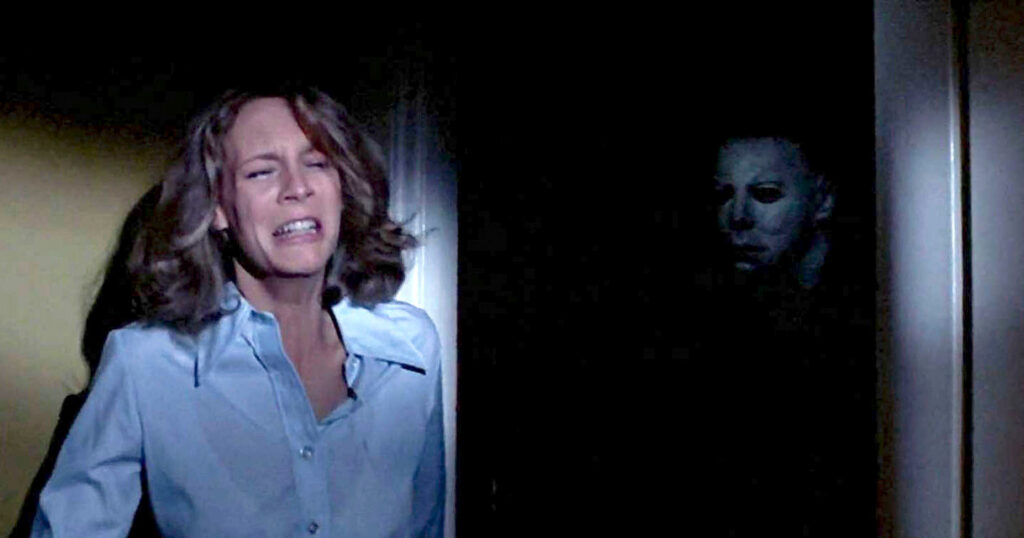
Additional Michael Myers Mask trivia!
- The Nicotine-Stained Prop: The reason the mask in Halloween II (1981) is a sickly, yellowish-beige (even though it’s the exact same mask as the original) is that producer Debra Hill kept the prop in a shoebox under her bed between films while being a heavy smoker. The latex absorbed the nicotine and smoke over three years, causing the drastic discoloration.
- The Inadvertent Blonde Michael: In a single, quick transition shot in Halloween 4: The Return of Michael Myers (1988), the mask is visibly blonde instead of the typical brown/black. This was due to the primary, flawed mask being briefly misplaced, forcing the crew to hastily use a different, un-modified blonde prototype mask for that one shot to keep filming on schedule.
- The Severely Warped Nose Appliance: The notably long, gaunt, and oddly scowling mask in Halloween 5: The Revenge of Michael Myers (1989) required a last-minute emergency fix. The original sculpt was too long for actor Don Shanks’ face, so the FX team had to surgically cut off the nose and glue a smaller, thinner appliance from another mask onto the face.
- The Stan Winston Reshoot Swap: Despite legendary effects artist Stan Winston being brought in late to create a new mask for reshoots in Halloween H20 (1998), the director ultimately decided to use the previously scrapped KNB EFX Group mask for the very last shot of the film (Michael’s execution), contradicting the Winston mask and the earlier CGI-replaced mask.
- The Mask That Was Almost Richard Nixon: When securing the prop for the 1978 original, production designer Tommy Lee Wallace presented director John Carpenter with three options: the Captain Kirk mask, a clown mask, and a President Richard Nixon mask. The Nixon mask was seriously considered before they opted for the Kirk mask, which they felt was easier to transform into an expressionless “Shape.”
Find even more info: on IMDB, on Wikipedia, and even on IMFDB.