

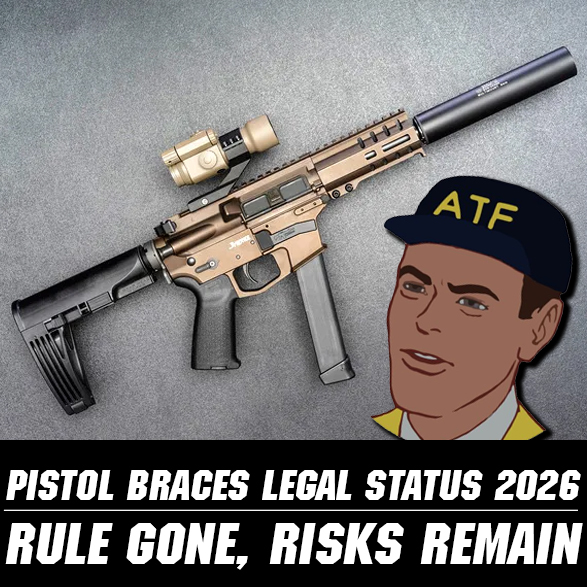
The ATF’s pistol brace saga took another twist in March 2026, and it’s a reminder that even when one battle ends, the war over firearm classifications isn’t necessarily over. If you’ve got an AR pistol or similar setup with a stabilizing brace, here’s the latest straight from recent court filings and ongoing developments.
The Big Win That Killed the 2023 Rule
Back in 2023, the ATF dropped its controversial Final Rule 2021R-08F (published January 31, 2023, in the Federal Register at 88 Fed. Reg. 6478). That rule used a set of “factoring criteria” to decide if many braced pistols should really count as short-barreled rifles (SBRs) under the National Firearms Act. If they did, owners faced NFA requirements: register the firearm, pay a $200 tax stamp, and risk felony charges for non-compliance.
Millions of gun owners pushed back hard. Lawsuits piled up across federal courts, arguing the ATF overstepped its authority, ignored public comments, and turned a popular accessory (originally marketed for better control, especially for those with disabilities) into a regulatory nightmare overnight.
By mid-2025, courts had enough. A federal judge issued a nationwide vacatur — basically wiping the rule off the books entirely. The Department of Justice under the new administration dropped appeals, and the rule was declared null and void. Pistol braces themselves aren’t banned, and braced pistols aren’t automatically reclassified as SBRs anymore. That part is settled — the brace rule is dead.
But Wait — ATF Isn’t Walking Away Entirely
In a March 16, 2026, filing in the ongoing case State of Texas et al. v. Bureau of Alcohol, Tobacco, Firearms and Explosives (U.S. District Court, Victoria Division), the ATF told the court the whole challenge is now moot because the rule no longer exists. Dismiss the case, they said — there’s nothing left to fight over under the Administrative Procedure Act.
At the same time, the agency dropped a clear warning in its brief: just because the specific 2023 rule is gone doesn’t mean every braced pistol is automatically in the clear forever.
The ATF’s position boils down to this:
- The vacated rule’s “factoring criteria” and points system? Irrelevant now.
- But the underlying statutes — the National Firearms Act and Gun Control Act — still apply.
- If a pistol with a brace is designed or intended to be shouldered, and it meets the statutory definition of an SBR (barrel under 16 inches or overall length under 26 inches), it’s still an NFA item.
- Owners in that situation must register it, pay any applicable fees/taxes (note: some NFA changes in 2026 made certain registrations fee-free, but requirements remain), or face potential prosecution.
From the filing itself: “If a pistol with a stabilizing brace is designed to be shouldered and meets the NFA’s definition… it remains a short-barreled rifle. Owners must still register it, pay the tax, or face prosecution.”
In other words, the ATF is saying: We don’t need that old rule to enforce the law the way we’ve always interpreted it. Case-by-case enforcement continues for configurations they view as crossing the line into SBR territory.
What This Means for Gun Owners Right Now
- Most braced pistols — especially those configured and used as intended (one-handed or forearm-braced) — are back to pre-2023 status: legal without NFA paperwork.
- Configurations that look and function obviously like shouldered rifles (e.g., very short barrels, clear stock-like use) could still draw scrutiny.
- The agency isn’t launching mass enforcement actions post-vacatur, but prosecutions have popped up in the past for clear-cut cases, and the March filing signals they’re not closing that door.
- Broader ATF changes under new leadership (like repealing zero-tolerance policies for dealers and reviewing old rules) suggest a less aggressive posture overall, but NFA basics haven’t vanished.
Gun rights groups and legal analysts see this as a partial victory — the blanket reclassification attempt failed spectacularly — but a sobering reminder that administrative interpretations can shift, and statutory definitions endure unless Congress acts (bills like H.R. 335 to repeal chunks of the NFA have been floated but aren’t law yet).
If you’re sitting on a braced setup, double-check your configuration against current NFA definitions. When in doubt, consulting a knowledgeable firearms attorney or staying plugged into updates from groups like GOA, FPC, or NRA-ILA makes sense. The brace fight showed how fast things can change — and how persistent the underlying debates really are.