


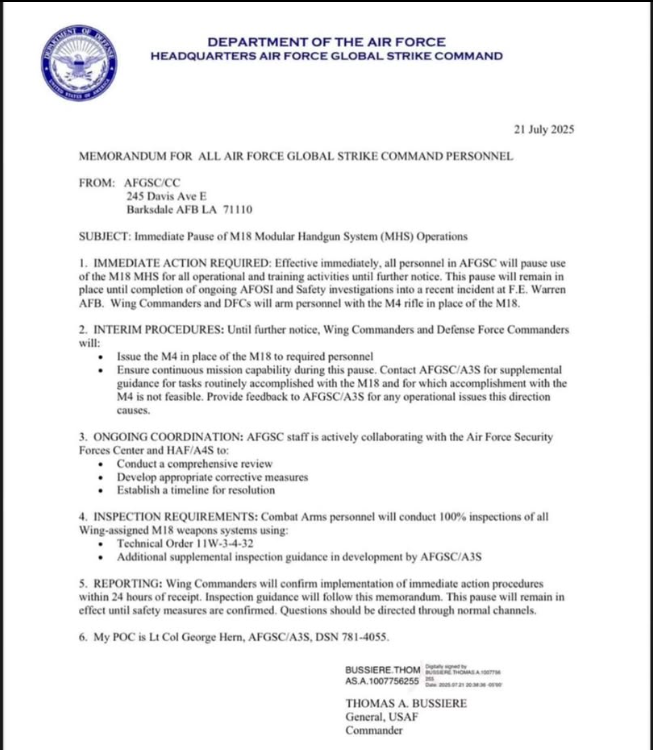
The U.S. Air Force Global Strike Command has temporarily halted the use of the M18 pistol following the death of a Security Forces airman at F.E. Warren Air Force Base in Cheyenne, Wyoming, on Sunday. This decision, announced on Monday, comes amid ongoing concerns about the safety of the M18 and its related model, the Sig Sauer P320, which have been linked to unintentional discharge allegations in multiple lawsuits.
What Happened at F.E. Warren Air Force Base?
The incident involved an active-duty airman from the 90th Security Forces Squadron, 90th Missile Wing. Details surrounding the event remain undisclosed, but the Air Force has described it as an isolated incident with no ongoing threat to the base or surrounding community. The Air Force Office of Special Investigations is leading the investigation, and the Global Strike Command is collaborating with the Air Force Security Forces Center to conduct a thorough review of the M18 pistol.
As part of the response, Security Forces combat arms airmen across all Global Strike Command bases are conducting 100% inspections of M18 handguns to identify potential safety issues. The pause in M18 use is effective “until further notice” and currently applies only to the Global Strike Command, which oversees more than 33,700 personnel.
The M18 Pistol and Sig Sauer P320 Controversy
The M18, a variant of the Sig Sauer P320, is the official sidearm for all branches of the U.S. military. However, the P320 has faced scrutiny due to allegations that it can discharge without the trigger being pulled. Sig Sauer, the New Hampshire-based manufacturer, has denied these claims, attributing incidents to user error and maintaining that the P320 is safe. The company has successfully defended itself in some lawsuits but faces ongoing legal challenges.
Since its introduction in 2014, the P320 has been adopted as the M17 and M18 pistols by the U.S. military. In 2017, Sig Sauer offered a “voluntary upgrade” to reduce trigger weight, but critics, including lawyers representing plaintiffs in lawsuits, argue that this did not resolve the issue of unintentional discharges.

Notably, earlier this year, the Washington State Criminal Justice Training Commission banned the P320, M17, and M18 after a recruit reported an unintentional discharge while drawing the weapon. Sig Sauer has appealed this decision, arguing it was based on inaccurate information. Meanwhile, the Michigan State Police recently adopted the M18 as its primary sidearm, highlighting the pistol’s continued use despite controversies.
Legal Battles and New Hampshire’s Response
Sig Sauer is defending itself against multiple lawsuits, including several large multi-plaintiff cases filed in New Hampshire’s federal court since 2022. These cases, representing nearly 80 plaintiffs, allege negligence and defective product design, particularly the lack of an external mechanical safety, which is optional on the P320. A recent case filed in March 2025 involves 22 plaintiffs across 16 states, with arguments heard this week on Sig Sauer’s motions to dismiss or transfer the lawsuit.
In response to these legal challenges, New Hampshire passed a law two months ago that prohibits product liability claims against gun manufacturers, including Sig Sauer, based on the presence or absence of optional features like external safeties. However, claims related to manufacturing defects are still permitted. This law has not yet been fully integrated into ongoing cases.
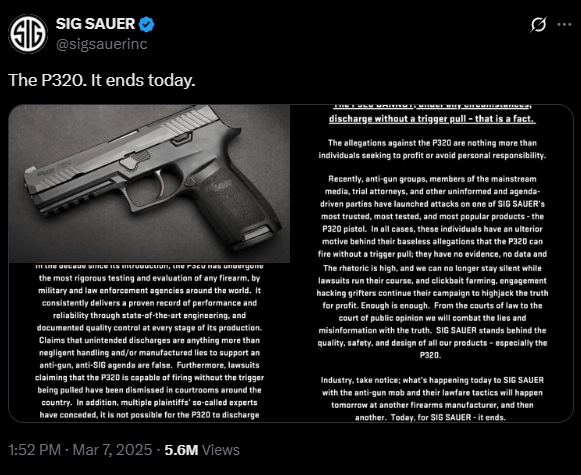
For now, the focus remains on ensuring the safety of service members while addressing concerns about the M18’s reliability. As the legal and investigative processes unfold, the controversy surrounding the Sig Sauer P320 and its military variants is likely to remain in the spotlight.