

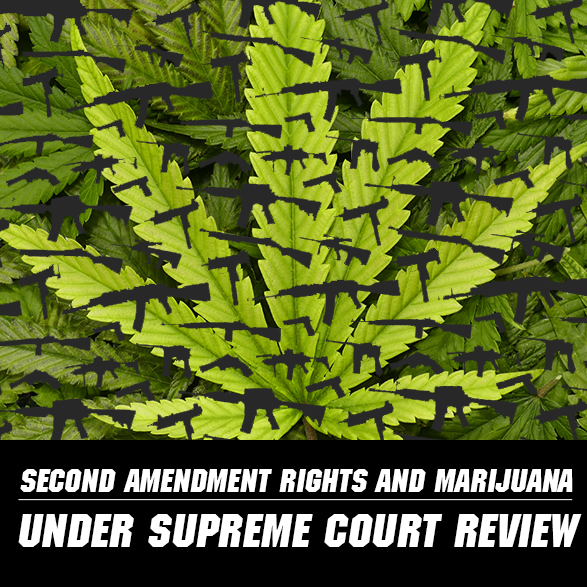
The Supreme Court is set to decide a major case that could reshape the intersection of Second Amendment rights and marijuana use under federal law. In United States v. Hemani, arguments are scheduled for March 2, 2026, with a decision expected by late June 2026. This case challenges whether the federal ban on firearm possession by “unlawful users” of controlled substances—including marijuana—violates the Constitution when applied to non-impaired, occasional users.
What Federal Law Is at Stake?
The core statute is 18 U.S.C. § 922(g)(3), part of the Gun Control Act. It prohibits anyone who “is an unlawful user of or addicted to any controlled substance” from shipping, receiving, or possessing firearms or ammunition. Marijuana remains a Schedule I controlled substance federally, even as most states allow medical or recreational use. This creates a conflict: millions of Americans who use cannabis legally under state law could face felony charges for owning guns.
The law doesn’t require impairment at the moment of possession—it’s about being an “unlawful user,” often interpreted as habitual or regular consumption.
Background on the Hemani Case
The case stems from a Fifth Circuit ruling (January 31, 2025) that sided with defendant Ali Danial Hemani. FBI agents searched his home, finding a 9mm pistol, 60 grams of marijuana, and a small amount of cocaine. Hemani was indicted under § 922(g)(3) as a habitual marijuana user.
A lower court initially leaned toward dismissal, and the Fifth Circuit reversed his prosecution, citing its prior decision in United States v. Connelly (2024). That case held there’s no historical basis under the Second Amendment to disarm sober individuals not actively impaired by drugs. The appeals court found the ban unconstitutional as applied to non-impaired marijuana users.
The government (via Solicitor General) appealed, arguing historical analogues—like Founding-era restrictions on “habitual drunkards”—justify disarming those posing risks of violence or crime.
The Supreme Court granted certiorari on October 20, 2025.
Key Arguments from Both Sides
Government Position (Pro-Ban):
- Historical tradition supports disarming dangerous individuals, including habitual substance users who could pose risks.
- Analogies to early laws treating drunkards as vagrants or confining them, plus modern restrictions on intoxicated persons.
- Supported by states, Everytown for Gun Safety, Brady Center, and others emphasizing public safety.
Challengers’ Position (Anti-Ban as Applied):
- No Founding-era laws disarmed sober citizens for occasional or moderate substance use.
- The ban is overly broad and vague—what counts as “unlawful user”? Occasional use a few times a week? Medical patients?
- Could strip rights from millions, including those using state-legal cannabis for pain or recreation.
- Backed by the NRA, NORML, ACLU (co-counsel for Hemani), Cato Institute, and others arguing it lacks historical grounding under Bruen.
Relevant Supreme Court Precedents Shaping the Debate
The case hinges on the history-and-tradition test from recent rulings:
- New York State Rifle & Pistol Association v. Bruen (2022): Modern gun laws must be consistent with the nation’s historical tradition of firearm regulation. If conduct is covered by the Second Amendment’s text, it’s presumptively protected unless the government shows analogues.
- United States v. Rahimi (2024): Upheld temporary disarmament for those posing credible threats of violence, finding historical support for disarming dangerous individuals.
Lower courts have split on § 922(g)(3) post-Bruen and Rahimi, with the Fifth Circuit leading challenges, while others vary.
Potential Implications
A ruling could:
- Affirm the Fifth Circuit, limiting the ban to cases of active impairment or proven danger.
- Uphold broader application, maintaining the status quo for federal prosecutions.
- Clarify vagueness issues or require temporal links (e.g., use near possession).
This matters amid growing state-legal cannabis markets—nearly half of Americans have tried marijuana, and many own guns. A decision might affect medical users, veterans, or casual consumers without impacting intoxication-while-armed laws.
The case is one of two major Second Amendment matters this term (alongside others on carry rights). Whatever the outcome, it will influence how courts apply history-and-tradition tests to modern prohibitions.