
The U.S. Army has just greenlit its first brand-new lethal hand grenade in nearly six decades — and it’s a game-changer for how soldiers fight in tight, urban spaces.
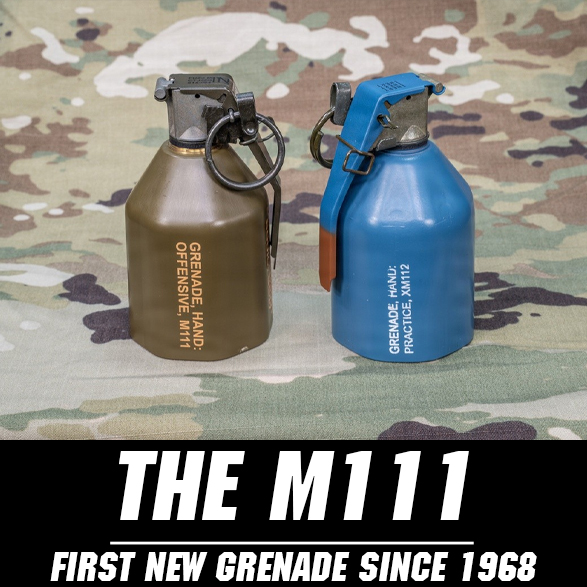
On March 10, 2026, the Army announced Full Material Release (FMR) for the M111 Offensive Hand Grenade (OHG), developed at Picatinny Arsenal by the Combat Capabilities Development Command (DEVCOM) Armaments Center and the Capabilities Program Executive Ammunition and Energetics team. This marks the first new lethal hand grenade approved since the Mk3A2 came online back in 1968. (Yes, that’s Vietnam-era tech we’ve been rolling with for over half a century.)
Why Ditch the Old Stuff?
The old Mk3A2 offensive grenade had issues — its body contained asbestos, so use got heavily restricted. The M111 swaps that out for a modern plastic body that fully consumes on detonation, no hazardous leftovers. But the real upgrade is how it kills.

Unlike the classic M67 fragmentation grenade (the pineapple-shaped one most folks picture), which sprays lethal shrapnel in every direction, the M111 leans hard into blast overpressure (BOP). Think massive pressure wave that crushes lungs, ruptures organs, and disorients anyone in the blast zone — without sending fragments flying through walls or bouncing around corners.
This shift comes straight from hard-learned lessons in places like Iraq, where door-to-door fighting in buildings made the M67 risky. Fragments could punch through thin walls and hit your own guys on the other side — fratricide was a real worry.
Col. Vince Morris, Project Manager for Close Combat Systems, put it bluntly:
“One of the key lessons learned from the door-to-door urban fighting in Iraq was the M67 grenade wasn’t always the right tool for the job. The risk of fratricide on the other side of the wall was too high. But a grenade utilizing BOP can clear a room of enemy combatants quickly leaving nowhere to hide while ensuring the safety of friendly forces.”
In enclosed spots like rooms, bunkers, trenches, or caves, the M111 shines because the pressure wave doesn’t get blocked or deflected the way fragments do. In open terrain? Stick with the M67 for max fragmentation lethality. Soldiers now get to pick the right tool for the job.

Specs and Design That Make Sense
The M111 is about 110 mm long, 59 mm wide, and weighs roughly 670 grams (around 1.5 lbs). It uses the same M213 pyrotechnic fuze and safety lever as the M67 — five-step arming process that’s already muscle memory for troops. That means training is seamless: train as you fight, no relearning curves.
It packs RDX Composition A-2 high explosive mixed with aluminum powder for that boosted blast. The body is plastic, bottle-shaped (distinct octagonal taper) so soldiers can grab the right one under stress without second-guessing.
A training variant, the M112, mirrors it for safe drills.
Manufacturer: Day & Zimmermann, Inc.
Blast Overpressure — Effective, But Not Without Risks
Blast overpressure is brutal: rapid pressure spikes can cause internal injuries even without visible wounds — lungs collapse, brains get rattled, guts tear. The Army knows this; they’ve studied overpressure effects from weapons like the Carl Gustaf recoilless rifle and set firing limits during training to protect troops.
The M111 weaponizes that same physics against enemies while minimizing friendly risks from stray fragments. It’s not eliminating overpressure danger entirely (thrower still needs distance/cover), but it isolates the worst effects to the target area better than shrapnel ever could in urban fights.
As one former Army mortarman and overpressure advocate noted, there’s some irony: we trust blast physics to take out bad guys, but we’re still figuring out long-term exposure for our own people.
Bigger Picture for the Force
This isn’t replacing the M67 — it’s augmenting it. The Army plans to field the M111 first to Immediate Response Forces (quick-deploy units), with wider rollout to other services around 2028.
It saves money too: shared fuzes with the M67/M69 training line mean economies of scale, competitive contracts, and government-owned IP for better pricing.
Tiffany Cheng, a DEVCOM engineer who helped develop it, summed up the win:
“We’ve given our Soldiers and joint warfighters the flexibility to determine in the field which type of grenade will best suit the current situation they are facing, be it open space or confined area.”
After decades of the same old grenades, the Army’s finally modernizing for the fights we’re actually in — urban, close-in, no place to hide.