


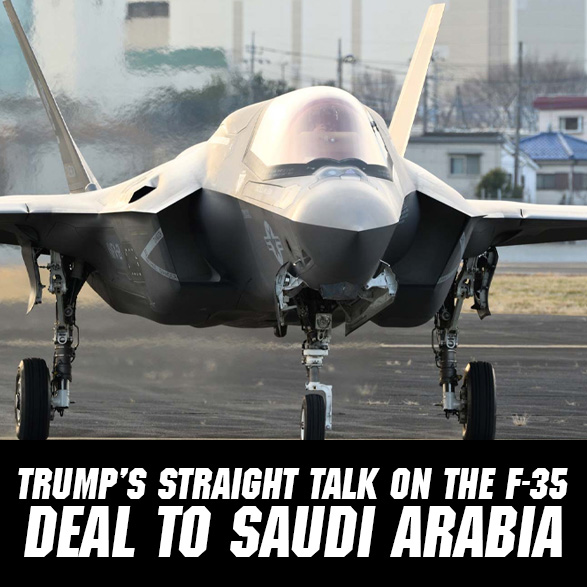
In a bold move signaling a thaw in US-Saudi relations, President Donald Trump announced on Monday that the United States will approve the sale of advanced F-35 fighter jets to Saudi Arabia. This potential US-Saudi arms deal—one of the most significant in recent memory—comes ahead of a high-stakes Trump MBS meeting at the White House, where broader security pacts and Middle East diplomacy hang in the balance. As the first non-Israeli Middle Eastern nation poised to acquire these stealth fighters, Saudi Arabia’s entry into the F-35 club could reshape regional power dynamics.
The Announcement: Trump’s Straight Talk on the F-35 Deal
President Trump didn’t mince words during his remarks on November 17, 2025. “They want to buy. They are a great ally. We will be doing that. We will be selling them F-35s,” he declared, emphasizing the mutual benefits of bolstering Saudi Arabia’s defenses. This comes just months after Trump’s May visit to Riyadh, where he met with Crown Prince Mohammed bin Salman (MBS), underscoring the duo’s enduring rapport.
The Saudi Arabia F-35 transaction isn’t just about hardware—it’s a cornerstone of Trump’s vision for Gulf alliances. The Lockheed Martin F-35 Lightning II, renowned for its stealth capabilities, sensor fusion, and multirole versatility, represents the pinnacle of US military aviation tech. Priced at over $80 million per unit, the deal could be worth billions, injecting life into American defense jobs while arming a key counterweight to Iran.
Yet, this isn’t a done deal. Any US-Saudi arms deal of this magnitude requires Congressional review, where bipartisan hawks and doves alike could scrutinize its implications. Trump’s history of touting “massive” arms packages to Gulf states—recall his first-term $110 billion Saudi shopping spree—suggests he’s betting big on economic and strategic wins.
Why Now? The Geopolitical Chessboard
Timing is everything in Middle East politics, and this announcement arrives amid swirling regional tensions. Saudi Arabia has long eyed the F-35 to modernize its air force, which currently relies on aging F-15s and Eurofighter Typhoons. The kingdom’s defense spending, already topping $75 billion annually, reflects its ambitions to project power from the Arabian Peninsula to the Red Sea.
Enter the Trump MBS meeting scheduled for Tuesday at the White House. Topping the agenda: a comprehensive US-Saudi security agreement that could include mutual defense clauses, intelligence sharing, and—crucially—progress toward Saudi normalization with Israel. This echoes the Abraham Accords Trump brokered in his first term, which normalized ties between Israel and several Arab states.
But here’s the rub: The F-35 sale isn’t happening in a vacuum. The US has a legal obligation under the 2008 Naval Vessel Transfer Act to preserve Israel’s “qualitative military edge” (QME)—a commitment ensuring Jerusalem’s tech superiority over adversaries. Selling the world’s most advanced fighter to Riyadh could tilt that balance, prompting concerns in Tel Aviv about aerial threats just a short flight away.
Israel’s Stance: Support with Strings Attached
Israel, the Middle East’s sole F-35 operator with over 50 jets in service, isn’t outright opposing the Saudi Arabia F-35 push—but it’s drawing red lines. “We told the Trump administration that the supply of F-35s to Saudi Arabia needs to be subject to Saudi normalization with Israel,” a senior Israeli official told Axios. Without diplomatic deliverables, they warn, “the U.S. giving Saudi Arabia F-35s… would be ‘a mistake and counterproductive.'”
Geography amplifies the stakes: “It takes minutes for an F-35 to fly from Saudi Arabia to Israel,” the official noted, hinting at potential demands like restricting Saudi deployments to eastern bases far from the border. Israel’s calculus is pragmatic—normalization could unlock economic boons and a united front against Iran—but unconditional arms sales risk eroding trust in US commitments.
This conditional green light from Jerusalem could grease the wheels for the deal, but it ties the F-35s directly to peace talks. If MBS delivers on normalization, it might pave the way for a historic realignment; if not, Congress or the White House could hit pause.
Broader Implications: A New Era for US-Saudi Ties?
If greenlit, the US-Saudi arms deal would mark a seismic shift. Saudi Arabia joining the F-35 club—home to over 1,000 jets across 19 nations—would democratize cutting-edge tech in the Gulf, potentially deterring aggression from Tehran while boosting interoperability with US forces. Analysts see it as a counter to China’s growing arms footprint in the region, where Beijing has inked deals for drones and missiles.
On the flip side, risks abound. Congressional Democrats, fresh off midterms, might invoke QME to block the sale, echoing past holds on Saudi weapons amid Yemen concerns. And for Trump, it’s a high-wire act: Success burnishes his dealmaker brand; failure invites accusations of favoritism.
As the Trump MBS meeting unfolds, watch for signals on normalization and security pacts. This isn’t just about jets—it’s about redrawing alliances in a powder-keg region.